Background and Experience
Pedram Hesam is the Chief Technical Officer of PNH Security Engineering Consultants, where he leads the technical work on every engagement.
He has more than 17 years of experience engineering protection against blast, vehicle impact and other extreme loads for government, defense, transportation and commercial clients. Before PNH, he worked at K&C; Hinman Consulting Engineers; and Wiss, Janney, Elstner Associates. His project experience spans government and military facilities, airport and transit systems, stadiums, test facilities and data centers.
He was principal investigator on a federally funded SBIR research program on threat, vulnerability and risk assessment of soft targets.
Areas of expertise
Credentials
- PhD, Civil EngineeringPurdue University
- PSP, Physical Security ProfessionalASIS International
- CSS&MPSPA Certified Security Supervisor and Manager
- ASTM F12 voting memberSecurity Systems and Equipment
Profiles: ORCID 0009-0008-6752-1130 · PSP badge (Credly) · LinkedIn
Publications, Speaking and Memberships
Pedram Hesam publishes and speaks on vehicle ramming, perimeter protection and the response of structures to extreme loads.
Publications and speaking
Peer-reviewed papers in Frontiers in Built Environment (2019) and the Journal of Disaster Research (2020), papers at the TRB Annual Meeting (2019, 2020) and the IABSE Symposium (2017), and an article in ASIS Security Management (2025). Speaker at GSX 2025, ISC East 2025 and ISC East 2026.
Memberships
ASTM Committee F12 on Security Systems and Equipment (voting member), ASCE/SEI, ACI, Transportation Research Board and FBI InfraGard.
Technical Guides by Pedram Hesam
These technical guides by Pedram Hesam explain how vehicle barrier ratings, vehicle dynamics, DoD antiterrorism standards and explosives quantity-distance work in practice.
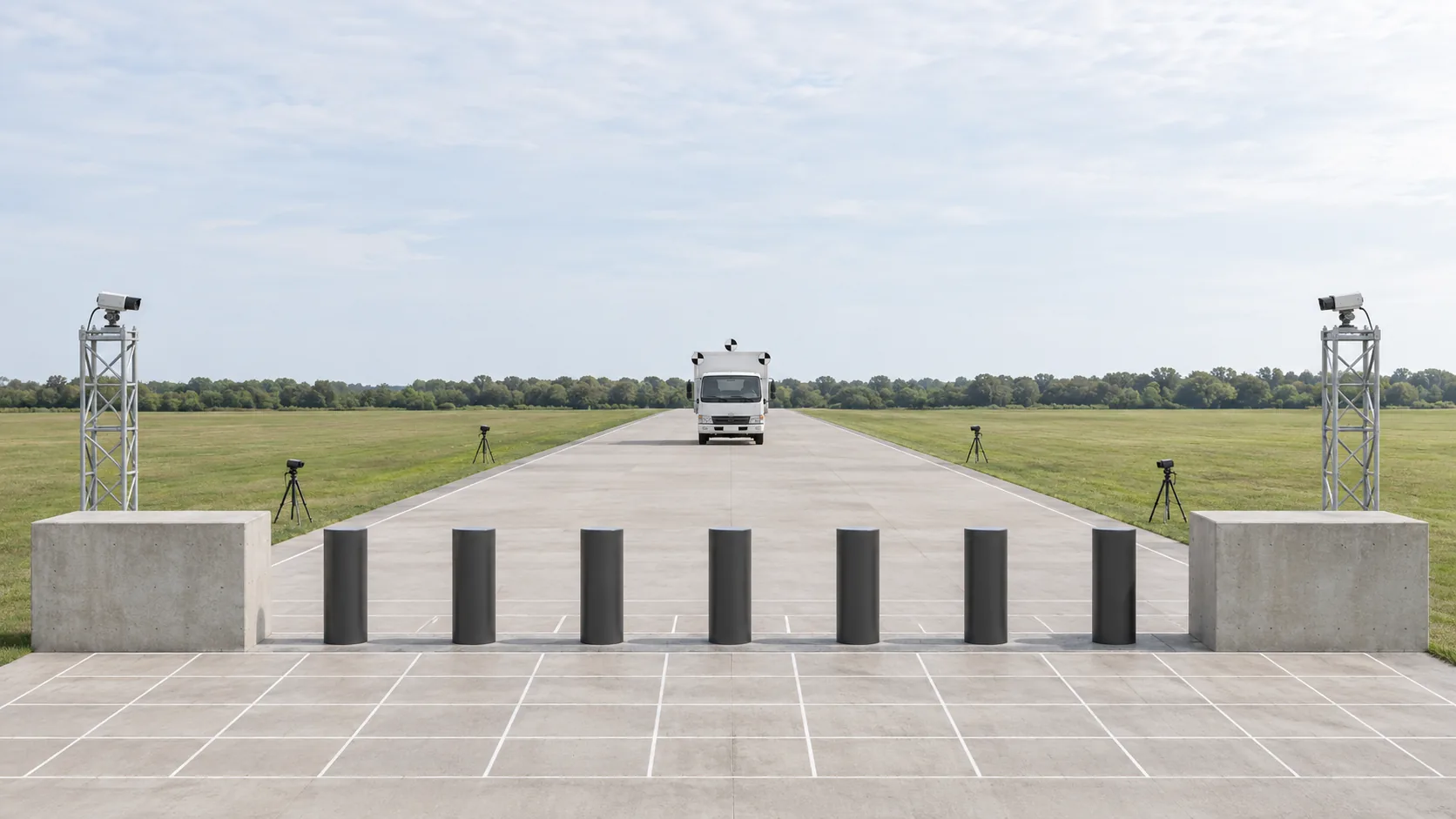
Vehicle Barrier Crash Ratings: How to Read ASTM F2656, ASTM F3016 and ISO 22343-1
What ASTM F2656 M30 to M50 and P1 to P3, ASTM F3016 S ratings and ISO 22343-1 codes mean, how to read a crash test report, and when a rating applies.
Read guide →
Vehicle Dynamics Assessment: Impact Speed, Angle and Rating at Every Barrier Line
How a vehicle dynamics assessment calculates impact speed, angle and energy at each barrier line, and sets the ASTM F2656 or ISO 22343-1 rating each needs.
Read guide →
UFC 4-010-01: DoD Antiterrorism Standards for Buildings, Explained
What UFC 4-010-01 requires, when it applies to a DoD building, how standoff works, and what changed in the 2026 digital reissue that absorbed UFC 4-020-01.
Read guide →
Explosives Quantity-Distance (QD) and Site Planning Under DESR 6055.09
How explosives quantity-distance works under DESR 6055.09: K-factors, IBD and PTRD math, hazard divisions, NEWQD and site plan approval.
Read guide →
Protective Design and Vehicle Mitigation Glossary
Plain definitions of HVM, ASTM F2656 and ISO 22343 crash ratings, impact speed and angle, standoff, UFC 4-010-01, DESR 6055.09 quantity-distance and more.
Read glossary →Briefings by Pedram Hesam
These briefings by Pedram Hesam explain current vehicle ramming and drone threats for owners and design teams.

Temporary Vehicle Barriers for December Events: What the Rating Covers and How to Deploy It
What a crash rating means for a free-standing or pinned barrier at a market, parade or New Year's Eve event, and how to deploy and check it so it performs.
Read briefing →
One Open Gap: Protecting Holiday Markets and Seasonal Events
In the deadliest recent attacks on markets and festivals, the barriers were there. The vehicle found the one opening that was not closed.
Read briefing →
It Is a Detonation Problem: Passive Protection Against One-Way Attack Drones
Catching an attack drone is the smallest part of the problem. What protects the asset is controlling where, and how far away, the warhead goes off.
Read briefing →About the Firm
PNH Security Engineering Consultants is an independent protective design and hostile vehicle mitigation engineering firm. Its services, certifications, standards and way of working are described on the About page.