Temporary Vehicle Barriers for December Events: What the Rating Covers and How to Deploy It
Markets, parades, tree lightings and New Year's Eve countdowns are often protected by barriers that sit on the street rather than in it. A crash rating for that kind of barrier holds only on the surface, in the arrangement and with the connections it was tested with, and this briefing explains how to keep it that way.
Briefing by Pedram Hesam, PhD, PSP, Chief Technical Officer, PNH Security Engineering Consultants. Updated .
What is a temporary vehicle barrier?
A temporary vehicle security barrier is one placed for a limited period and removed afterward, either free-standing on the existing surface or pinned or bolted into it, rather than set in an excavated foundation.
ISO 22343-2:2023 (5.2.2) separates permanent installations, semi-permanent ones (removable elements on a foundation or anchorage left in place) and temporary ones that stay a short time and need minimal remedial work on removal. NPSA's Catalogue of Security Equipment codes foundations A (free-standing, no ground fixings), Ap (surface mounted, pinned or bolted), B (no deeper than 0.5 m, about 20 in) and C (deeper). Event barriers are usually A or Ap.
An embedded bollard resists through its foundation and the ground around it; a free-standing unit resists through its mass, its contact with the ground and its links to neighboring units, so it moves when struck. For the attack record and why seasonal sites fail, see One Open Gap.
Are temporary or surface-mounted vehicle barriers crash rated?
Many are: free-standing and pinned barriers are impact tested to ISO 22343-1:2023, ASTM F2656/F2656M-23 or the withdrawn IWA 14-1 and PAS 68, but each rating covers only the tested configuration.
ISO 22343-1:2023 illustrates barriers placed on, and pinned or bolted to, the test site ground (Figure 1), and its scope notes that a barrier is designed and tested for the threat vehicle, the climate and the intended site, such as rigid or non-rigid soil or a finished surface. ASTM F2656/F2656M-23 tests surface-mounted barriers on a surface set by the supplier in consultation with the test director, documents the test bed profile to 0.6 m (2 ft) deep (7.2.3), and requires the surface to replicate anticipated field deployed conditions (7.2.1) and the test article to represent the service installation (7.3).
For a temporary system, "as tested" means the surface and what lay under it, the pins or ballast, the connectors, the number of units, the length, the gaps and which unit was struck. NPSA and NaCTSO state that ratings apply only to the as-tested configuration, layout or arrangement, and that changes should be declared and reviewed by the installer and the risk owner.
An impact rating describes one hit: ISO 22343-1 tests a single impact and excludes slow-speed nudging and ramming (Clause 1). NPSA and NaCTSO recommend temporary barriers that also hold a 30 or 60 second rating under NPSA's Vehicle Attack Delay Standard (VADS), which tests repeated ramming, and warn that a VADS-only barrier may not stop a high-speed impact.
Why do ground surface, slope and weather matter?
A temporary barrier's rating depends on the ground it was tested on, so the same unit can behave differently on asphalt, concrete, pavers or grass.
ISO 22343-2:2023 states that varying the foundation type or the surface on which a barrier is placed can affect its performance, and that further testing can be required if tested and site conditions differ (7.5.1). It recommends that a suitably qualified engineer assess non-standard site conditions (7.5.1) and the ground (7.5.2). A pin rated in concrete is not automatically rated in asphalt over a granular base, and a unit tested on a rigid slab may respond differently on pavers or turf. ISO 22343-2 also gives surface-placed barriers their own subclause (7.5.4).
ASTM F2656 describes the test area as, in general, level (7.2.1), while ISO 22343-2 asks the site survey to consider the road surface, curbs, verges, gradients, camber and crossfall at and in advance of each barrier location (7.3). The same clause lists frost, snow and ice among conditions to identify, and 7.5.1 names locations frequently below -10 °C (14 °F). Unless the test report shows otherwise, a unit set on ice or packed snow is outside its tested condition and calls for engineering judgment.
How far does a struck temporary barrier move?
A free-standing barrier moves with the vehicle that hits it, so the clear zone behind the line must come from the test report, not from the barrier's footprint.
ISO 22343-1 measures vehicle penetration from the barrier datum line, at the foremost point of the structure designed to resist impact. It also reports major debris distance, which NPSA describes as the distance from the barrier's original front face to the furthest piece of debris of 2 kg (4.4 lb) or more. ASTM F2656 assigns penetration bands (P1 to P3) and does not rate debris. NPSA and NaCTSO note that a vehicle striking a temporary barrier can take several meters to stop and propel significant debris forward, and advise sufficient stand-off and a sterile zone.
Penetration in both standards is measured to a reference point on the vehicle, the leading edge of the load bed on a truck, so a truck's cab and engine stop further forward than the rated figure. Measured from the barrier's original front face, queues, seating, stalls and stages belong beyond both the furthest point the vehicle reaches (reported under ISO 22343-1, or the rated penetration plus the vehicle ahead of its reference point) and the major debris distance, with more room where the site differs from the test. See how to read a vehicle barrier crash rating.
Linked systems, gaps and line ends
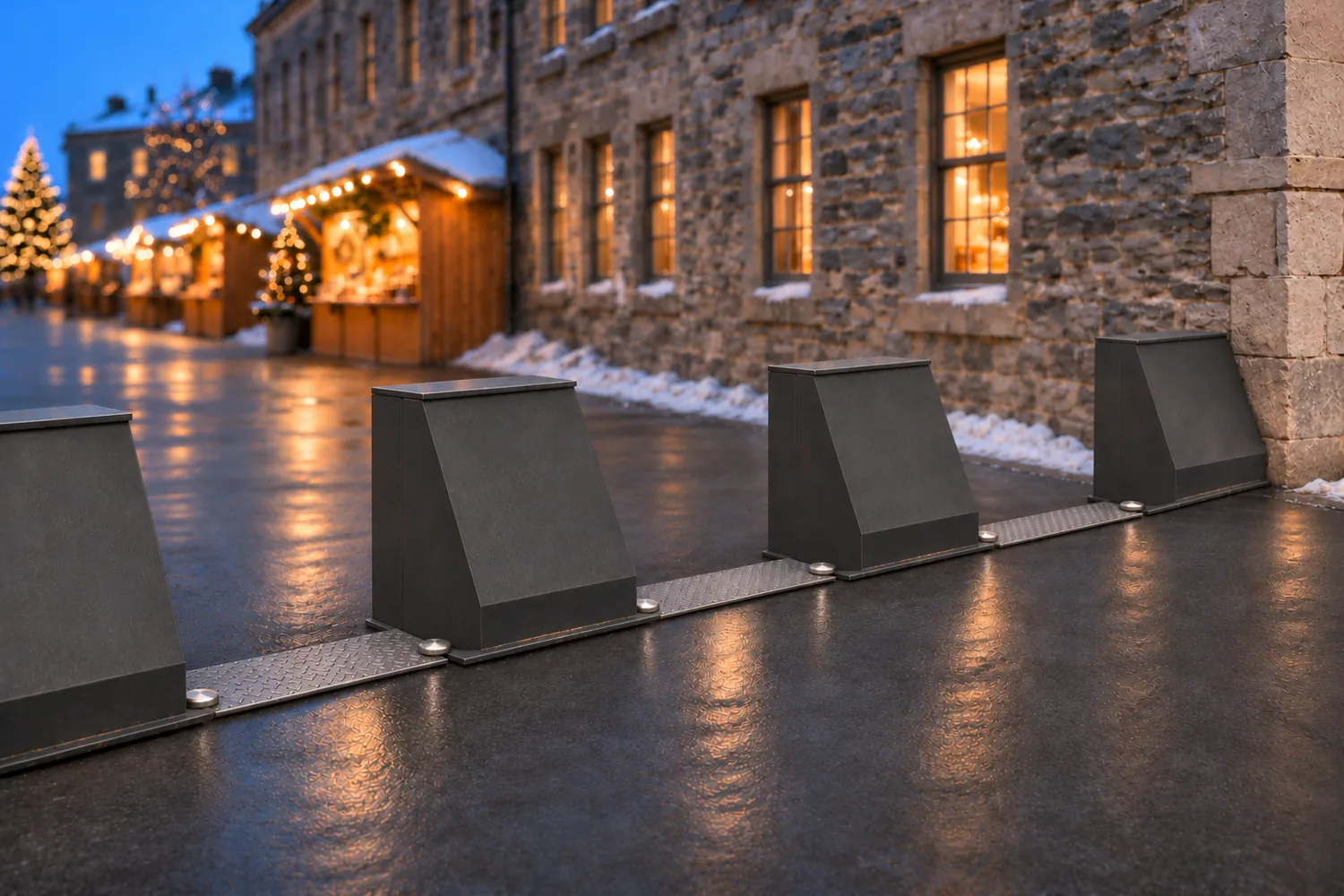
A linked temporary system is rated as a run of a stated number of connected units, so a single unit, a shorter run or a run with missing connectors is not the rated barrier.
The test report should state whether one unit or a linked run was struck, how many units were joined and how. ASTM F2656 requires the maximum horizontal distance between two barriers, above the finished ground, to be recorded (6.5).
NPSA and NaCTSO advise that air gaps be no wider than 1.2 m (about 47 in), and ask whether the barriers can be driven around. A smaller tested gap governs; PNH layouts typically keep 36 to 46 in of clear spacing. Every line must end against a building, another rated element or a feature a vehicle cannot cross, never in open ground. ISO 22343-2 (7.3) asks the site survey to find every traversable route, including footways, open spaces and gaps, and to expect hostile vehicles against the direction of traffic.
Do water-filled barriers, jersey barriers or planters stop a truck?
Not unless that exact product, in that arrangement, has an impact test report: ordinary water-filled barriers, concrete jersey barriers and planters are traffic-control or landscape items with unknown performance against a deliberate attack.
CISA's vehicle incident security guide describes jersey barriers as concrete or plastic road barriers, standalone or water or sand filled (Table 8), says an unrated device's ability to stop a hostile vehicle is "unknown" and should not be relied on, and warns that "something is better than nothing" can create a false sense of security. Some proprietary planters and blocks are impact rated, and NPSA's impact-rated catalog lists planters under street furniture. The test report, not the shape, decides.
Parked vehicles follow the same rule. CISA lists vehicle blocking with dump trucks or larger commercial vehicles among mitigation tools (Table 4), and NPSA's impact-rated catalog has a "vehicle as barrier" category for tested vehicles. Unless that vehicle and position were tested, a blocking truck or bus is unrated: an engineering judgment on its mass, orientation, end gaps and whether it is staffed and immobilized, and never an unattended closure for a planned opening.
How should temporary barriers handle emergency vehicle access?
Every lane that must open for fire, EMS or police needs a rated movable element in the barrier line and a named operator, not a gap, a chain or an unrated gate.
ISO 22343-2 lists emergency services among the legitimate vehicles a traffic survey should identify, counts long-wheelbase emergency equipment among over-sized vehicles, and names movable barrier elements as a contingency for infrequent over-sized access (7.4). NPSA and NaCTSO ask who will operate or supervise the barrier in and out of core hours and how it is secured when closed, and stress operator training. CISA advises creating a designated first responder route shared well ahead of the event, pre-arranging unrestricted access where barriers cannot be moved, and placing barriers so they do not create crowd choke points.
The movable element can be a rated gate or swing section within the tested system, or a tested vehicle used as a movable barrier, sized for the largest fire apparatus and opened only by the named operator.

What to check when temporary barriers are installed
Before an event opens, every temporary barrier line should be checked item by item against the full test report, from product and configuration to clear zone and condition.
- Product. Model, standard, edition and test laboratory match an authentic test report and certificate, as CISA advises.
- Configuration. Number of units, linked length and layout match the test.
- Surface. Same surface type as tested, slope and crossfall within what the report covers, and the footprint clear of ice and packed snow.
- Anchoring or ballast. Pin count, size, embedment and substrate as tested; ballast filled to the tested level.
- Connectors. Every connector present, of the tested type, and locked.
- Gaps. Measured clear gaps no wider than the tested gap or 1.2 m (about 47 in), whichever is smaller.
- Orientation. Each unit faces the approach the way the test unit faced the test vehicle.
- Ends and openings. Every line end tied into a building, another rated element or a feature a vehicle cannot cross, none in open ground; movable elements closed, locked and assigned to a named operator.
- Clear zone. Nothing occupied within the furthest vehicle position and the major debris distance in the test report, measured from the barrier's front face.
- Condition and record. No cracked, bent or modified units; each line photographed, measured and signed off by the person accepting it.

Reusing barriers across seasons, and who signs off
A temporary barrier keeps its rating only while it remains the as-tested article, so units that have been struck, cracked, bent or repaired with non-original parts or methods, and units missing connectors, should be withdrawn until the manufacturer confirms them; ISO 22343-2 treats changes to a barrier in its Annex C on modifications.
CISA notes that mounted barriers need regular maintenance to remain crashworthy and advises keeping current on service, repairs and spare parts. ISO 22343-2 gives guidance on commissioning and handover (10.5), deployment and removal (Clause 11) and maintenance, service and inspection (Clause 15). Inspect after every deployment.
NPSA and NaCTSO place sign-off with the risk owner, ask whether the person signing off the installation on the ground is suitably qualified and experienced, and strongly recommend that impact ratings meet or exceed the stated threat in vehicle size, approach speed and penetration distance. For events that recur at one location, ISO 22343-2 (5.2.2) recommends weighing permanent or semi-permanent installations against repeated temporary deployment, which NPSA and NaCTSO call less cost effective in the longer term.
How PNH reviews temporary HVM
PNH Security Engineering Consultants reviews temporary hostile vehicle mitigation independently; it does not make, sell, hire or install barriers, so the review follows the site and the evidence.
PNH's Chief Technical Officer sets the credible speed and angle at each opening through a vehicle dynamics assessment, then checks each proposed barrier's test evidence against that demand and against the actual surface, slope, unit count, connectors, gaps, line ends, emergency access and clear zone, and checks installation photographs and measurements against the test report. The review can stand alone or form part of a vehicle ramming assessment or a hostile vehicle mitigation design. To have a temporary HVM proposal reviewed before December, contact PNH.
References
- ISO 22343-1:2023, Security and resilience: Vehicle security barriers, Part 1: Performance requirement, vehicle impact test method and performance rating, edition 1, ISO (https://www.iso.org/standard/50080.html)
- ISO 22343-2:2023, Security and resilience: Vehicle security barriers, Part 2: Application, edition 1, ISO (https://www.iso.org/standard/81415.html)
- ASTM F2656/F2656M-23, Standard Test Method for Crash Testing of Vehicle Security Barriers, approved November 1, 2023, ASTM International (https://www.astm.org/f2656_f2656m-23.html)
- Hostile Vehicle Mitigation: Considerations for Temporary Vehicle Security Barriers, v3.2, NPSA and NaCTSO, 2025 (https://www.protectuk.police.uk/sites/default/files/2025-02/Considerations%20for%20Temporary%20Vehicle%20Security%20Barriers%20v3.2.pdf)
- HVM Impact Rated: rating system explained, NPSA, March 2024 (https://www.npsa.gov.uk/sites/default/files/cse-hvm-impact-rated-rating-system-explained-npsa-20240301.pdf)
- Vehicle Incident Prevention and Mitigation Security Guide, Cybersecurity and Infrastructure Security Agency, April 2024 (https://www.cisa.gov/sites/default/files/2024-04/Vehicle_Incident_Prevention_and_Mitigation_Security_Guide_508_20240418.pdf)
Editions change. PNH confirms the governing edition for each project.
Terms used here are defined in the Protective Design and Vehicle Mitigation Glossary.

ABOUT THE AUTHOR
Pedram Hesam, PhD, PSP, is Chief Technical Officer of PNH Security Engineering Consultants, where he leads the protective design, blast, impact and hostile vehicle mitigation engineering for critical infrastructure and public facilities. He has more than 17 years of experience in blast and antiterrorism engineering. He holds a PhD, Civil Engineering, from Purdue University and the Physical Security Professional (PSP) credential from ASIS International, is a voting member of ASTM Committee F12, and co-authored “Mitigating Vehicle Ramming Threats with Layered Protection” (Security Management, September 2025).
Related Services

Hostile Vehicle Mitigation
Every credible approach route, the speed a vehicle can reach at each barrier line, and the tested rating that stops it.
Learn more →
Vehicle Ramming Assessment
A six-step assessment of every credible vehicle approach and the rating each barrier line needs.
Learn more →
Storefront Protection
Low-speed vehicle protection for retail frontages, plazas and outdoor dining.
Learn more →Common Questions
Are temporary or surface-mounted vehicle barriers crash rated?
Many are, under ISO 22343-1, ASTM F2656 or the withdrawn IWA 14-1 and PAS 68. The rating covers only the tested surface, anchoring or ballast, connectors, number of units, length and gaps. A different surface or arrangement needs engineering review, and NPSA and NaCTSO also recommend a VADS rating for repeated ramming.
Will a water-filled barrier or concrete jersey barrier stop a truck?
Not reliably, unless that exact product and arrangement has an impact test report. Ordinary water-filled and jersey barriers are traffic-control devices, and CISA describes an unrated device's ability to stop a hostile vehicle as unknown. Some proprietary blocks and planters are impact rated, so ask for the test report.
Can a parked truck or bus be used as a vehicle barrier?
Only as an unrated measure, unless that vehicle type and placement were tested. CISA counts blocking with dump trucks or other large commercial vehicles among its mitigation tools, and NPSA's impact-rated catalog has a vehicle-as-barrier category for tested vehicles. Otherwise mass, orientation, end gaps and whether the vehicle is staffed and immobilized decide whether it holds, and an unattended vehicle should never close a planned opening.
How wide can the gap between temporary barrier units be?
No wider than the gap in the test report, and NPSA and NaCTSO advise air gaps no wider than 1.2 m (about 47 in). PNH layouts typically use 36 to 46 in of clear spacing. Every line must also end against something a vehicle cannot cross, never in open ground.
Does a temporary barrier's rating still apply on snow or ice?
Not automatically. ISO 22343-2 lists frost, snow and ice among site conditions to identify, and notes that the surface a barrier sits on can affect its performance. Clear the footprint, and if the test surface differs from the site, have an engineer assess it.
Who signs off a temporary HVM deployment?
NPSA and NaCTSO place sign-off of the scheme with the risk owner, after the risk, the mitigation options and the residual risk have been explained. The installation itself should be accepted on the ground by a suitably qualified and experienced person, checked against the test report.
Discuss Your Project With PNH
Send the site and the question. PNH replies within one business day.
- The siteAn address, a site plan or a few photos.
- The concernThe threat question, an incident or a client requirement.
- The criteriaAny standard or client specification that applies.
- The dateWhen the tender, review or decision is due.
Email pnhsec@pnhsec.com or call +1-818-253-9557