Explosives Quantity-Distance (QD) and Site Planning Under DESR 6055.09
Quantity-distance sets how far a stock of explosives must be kept from people, roads, buildings and other explosives. This guide explains the formula, the hazard divisions and the explosives safety site plan, and how PNH Security Engineering Consultants supports each step as an independent engineer.
Technical guide by Pedram Hesam, PhD, PSP, Chief Technical Officer, PNH Security Engineering Consultants. Updated .
What quantity-distance (QD) means
Quantity-distance (QD) is the minimum separation required between a potential explosion site (PES) and an exposed site (ES), set by the hazard division and the net explosive quantity at the PES. For U.S. Department of Defense facilities the governing document is the Defense Explosives Safety Regulation (DESR) 6055.09, which replaced DoD 6055.09-M, "DoD Ammunition and Explosives Safety Standards," Volumes 1 to 8. Edition 1 was issued January 13, 2019; the current version posted on DENIX is Edition 1, Change 2, dated November 25, 2025.
QD criteria are based on blast, fragment, firebrand, thermal and ground shock effects, and the effect requiring the greatest distance governs (V1.E7.1.1.3). Distances are measured along straight lines from the nearest wall of the PES to the nearest part of the ES (V1.E7.4.1 and V1.E7.4.2). The DESR is published through the Department of Defense Explosives Safety Board (DDESB), named the Department of War Explosives Safety Board (DWESB) since 2025 according to Technical Paper (TP) 15, Revision 5.
The scaled distance formula: D = K x W^(1/3)
QD distances take the form D = K x W^(1/3), where D is distance in feet, W is the net explosive weight for QD (NEWQD) in pounds, and K is a factor that depends on the risk assumed or permitted (DESR V1.E7.5.1). In metric units the form is D = Km x Q^(1/3), with D in meters and Q in kilograms; K is approximately 2.52 times Km. Cube-root scaling means doubling the quantity increases the distance by only about 26 percent, and a smaller K means a closer exposure and a higher accepted overpressure, for example about 1.2 psi at 40W^(1/3) and 12 psi at the barricaded 9W^(1/3) (V3.E3.1.1).
HD 1.1 values for a PES other than an earth-covered magazine (ECM); other PES types have their own columns and tables:
| Exposure (HD 1.1) | DESR criterion | Metric |
|---|---|---|
| Inhabited building distance (IBD), NEWQD over 30,000 to 100,000 lb | 40W^(1/3) (Table V3.E3.T1) | 15.87Q^(1/3) |
| IBD, NEWQD over 100,000 to 250,000 lb | 2.42W^0.577 (Table V3.E3.T1) | 1.164Q^0.577 |
| IBD, NEWQD over 250,000 lb | 50W^(1/3) (Table V3.E3.T1) | 19.84Q^(1/3) |
| Public traffic route distance (PTRD) | 60 percent of applicable IBD, that is 24W^(1/3) to 30W^(1/3) | 9.52Q^(1/3) to 11.9Q^(1/3) |
| Intraline distance (ILD), unbarricaded | 18W^(1/3), about 3.5 psi (Table V3.E3.T4) | 7.14Q^(1/3) |
| ILD, barricaded | 9W^(1/3), about 12 psi (Table V3.E3.T4) | 3.57Q^(1/3) |
| Intermagazine distance (IMD) | K1.1 to K11, by PES and ES type and orientation (Table V3.E3.T6) | By table |
| Hazardous fragment distance (HFD), NEWQD 451 to 30,000 lb | Minimum 1,250 ft, PTRD 750 ft (V3.E3.1.2) | 381 m, PTRD 228.6 m |
Hazard divisions 1.1 to 1.6 and how they drive distance
The hazard division (HD) decides which effect governs the distance: blast for HD 1.1 and 1.5, fragments for HD 1.2 and fire and heat for HD 1.3, while HD 1.4 and HD 1.6 have their own reduced criteria. The divisions follow the UN Class 1 system, also defined at 49 CFR 173.50.
| HD | Hazard | Effect on QD |
|---|---|---|
| 1.1 | Mass explosion | Blast scaled by NEWQD; for a PES other than an ECM, fragments and debris control IBD below 30,000 lb |
| 1.2 | Projection, no mass explosion | Fragment-based; subdivisions 1.2.1 (NEWQD over 1.60 lb, or fragmentation similar to or greater than M1 105 mm projectiles), 1.2.2 (NEWQD of 1.60 lb or less, or fragmentation no greater than 40 mm HE ammunition) and 1.2.3, with the maximum credible event used in certain cases |
| 1.3 | Fire, with minor blast or projection | Heat flux is the greatest hazard and firebrands can travel more than 50 ft (V1.E8.4.3 and V1.E8.4.5); own tables (Table V3.E3.T14) |
| 1.4 | Moderate fire, no significant blast or fragment | No blast and no fragments of appreciable energy; small distances (Table V3.E3.T15) |
| 1.5 | Very insensitive, mass explosion hazard | Always treated as HD 1.1 for QD (V1.E7.2.3.1.3) |
| 1.6 | Extremely insensitive articles, no mass explosion | Effects similar to HD 1.3 (V1.E8.7); QD based on storage location and configuration (V3.E3.5, Table V3.E3.T16) |
When HD 1.1 is mixed with any other HD, the mixture is treated as HD 1.1, except as noted in V1.E7.2.3.2. HD 1.4 does not add to the NEWQD of a mixture, although HD 1.4 criteria still apply (V1.E7.2.3.1.1), and when a facility is used for several operations, the HD requiring the greatest separation sets its QD (V1.E7.3.1.2).
Potential explosion sites, exposed sites and NEWQD
Every QD analysis pairs a potential explosion site (a magazine, operating building, stack or pad holding explosives) with each exposed site it could harm: another magazine (IMD), a related operating building (ILD), a public road or railway (PTRD) or an inhabited building (IBD). A magazine is usually both a PES and an ES, so pairs are checked in both directions.
The quantity in the formula is the net explosive weight for QD (NEWQD). For HD 1.1, NEWQD equals the net explosive weight: the total high explosive weight plus the total net propellant weight (V1.E7.2.2.1). Fillers that do not contribute to explosive effects, such as smoke compositions and dyes, are excluded (V1.E7.2.2.7).
How inhabited building and public traffic route distances are calculated
Inhabited building distance for HD 1.1 above 30,000 lb NEWQD is calculated from Table V3.E3.T1 of the DESR, and public traffic route distance is 60 percent of that IBD. Worked example, PES other than an ECM:
- NEWQD of 50,000 lb HD 1.1 falls in the 30,000 to 100,000 lb range, so IBD = 40 x 50,000^(1/3) = 40 x 36.8 = about 1,474 ft (449 m).
- PTRD = 0.60 x 1,474 = about 884 ft (269 m).
Running the formula backward gives the maximum allowable explosive quantity: W = (D / K)^3. An inhabited building 1,600 ft from the PES allows (1,600 / 40)^3 = 64,000 lb (about 29,000 kg) NEWQD, valid because it stays inside the 30,000 to 100,000 lb range of the K40 equation.
Below 30,000 lb NEWQD, IBD from other PESs is controlled by fragments and debris rather than blast. The hazardous fragment distance is where hazardous fragment density falls to one per 600 square feet; for 451 to 30,000 lb the minimum is 1,250 ft (381 m), PTRD is 60 percent of that HFD, and Table V3.E3.T2 gives smaller values for 450 lb or less. Lesser distances are permitted if supported by a structural analysis (V3.E3.1.2).
Explosives safety site plans: contents and approval
An explosives safety site plan is the submission showing that a new or modified explosives facility, or a non-explosives facility inside QD arcs, meets DESR 6055.09; it is approved by the DoD Component and then reviewed and approved by the DDESB (V1.E5.2). DESR V1.E5.3 lists cases that need no Board submission, such as HD 1.4S storage, though Component rules still apply.
A final site plan includes the items in V1.E5.2.3.3, in summary:
- The DoD Component's approval in the transmittal document.
- Drawings at a scale of 1 inch to not more than 400 ft, showing distances to all exposed sites within the affected QD arcs, including utility lines, the installation boundary and public highways and railways.
- Use and occupancy of each exposed site within IBD.
- The net explosive weight for each hazard division to be stored or handled.
- Personnel limits, construction details and the arrangement of explosives operations.
- A summary of design procedures, loads and assumptions for any engineered protection not already approved by the DDESB, and any deviations from the standards.
Technical Paper 26, Revision 1, "Guidance for Explosives Safety Site Plans" (September 15, 2025), gives submission guidance, and DoDI 6055.16 describes the categories of explosives safety submissions (V1.E5.1).
Waivers, exemptions and Secretarial certifications
When strategic or compelling operational requirements make it necessary to deviate from QD or other DESR criteria, the DESR allows written deviations, and the DoD Component must acknowledge, accept and document the added risk (V1.E3.1). A waiver permits temporary deviation and is generally granted for no more than 5 years and reviewed by the DoD Component at least every 2 years (V1.E3.2). An exemption permits long-term noncompliance for strategic or compelling operational reasons and is reviewed at least every 5 years (V1.E3.3). A Secretarial exemption or certification is granted by the Secretary of a Military Department to allow construction of a new PES or ES that deviates from the standards (V1.E3.4), and compensatory measures alone do not remove that requirement for the new construction it covers.
When analysis and protective construction justify reduced distances
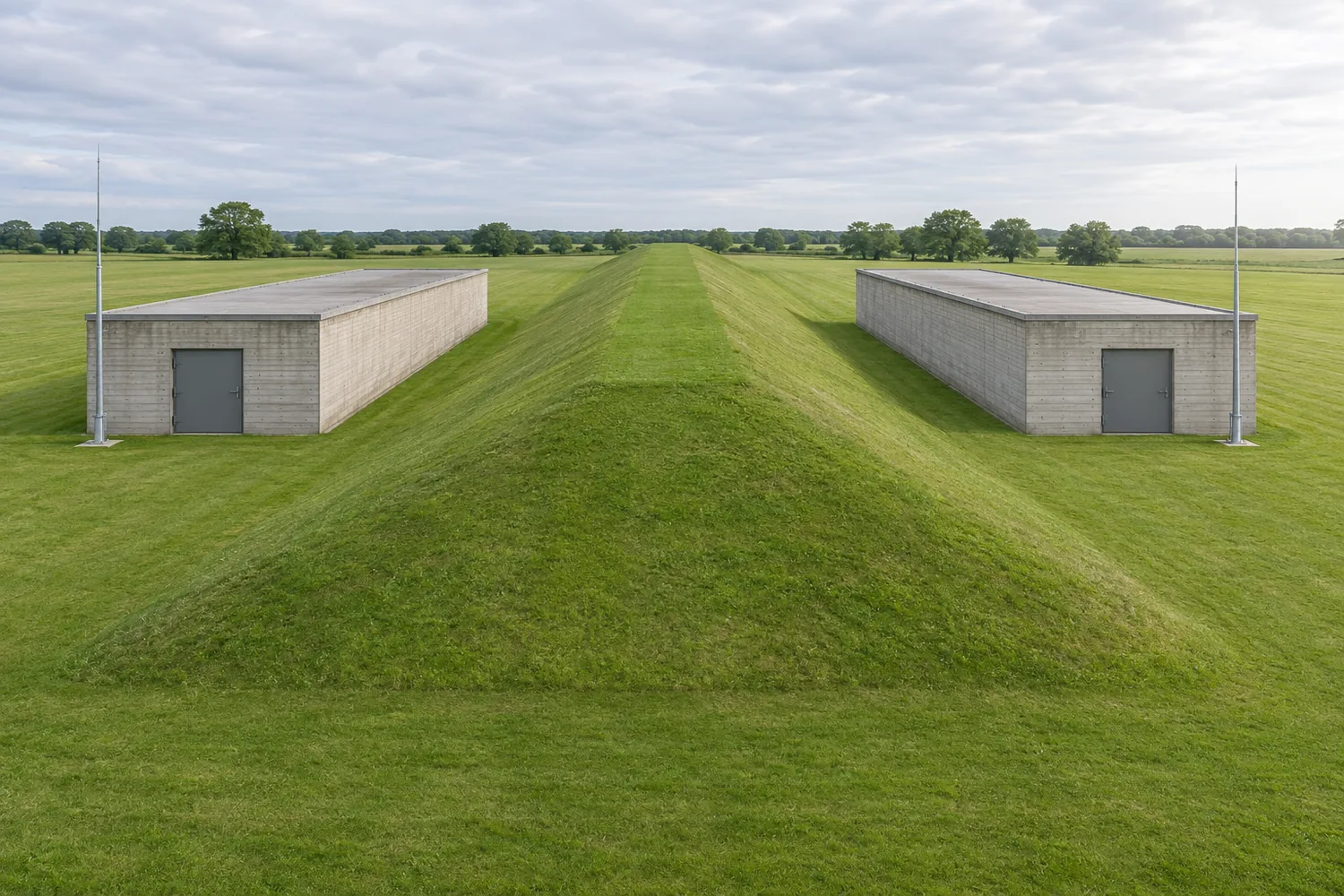
The DESR allows protective construction to reduce the separation distances in the QD tables, provided the rationale and supporting data are submitted to the Board with the site and general construction plans for approval (V2.E5.1.3). Earth-covered magazines are classed by structural strength designator (7-Bar, 3-Bar or undefined) against the approved designs listed in TP 15, need at least 2 ft of earth cover over the top, and a change in designator requires Board approval. Barricades interrupt the line-of-sight path of the shock wave and low-angle fragments but give no protection against high-angle fragments; the entire width of the crest must be at least 1 ft above the line of sight between the tops of the two explosives stacks, earthen barricades need side slopes of 2 horizontal to 1 vertical unless erosion controls are used, and approved designs are listed in Chapter 6 of TP 15.
Site-specific blast analysis supports these cases: confined detonations, venting, wall and roof response and fragment containment. The usual design basis is UFC 3-340-02, Structures to Resist the Effects of Accidental Explosions, and the DESR expects explosion-resistant facilities to be designed by engineers experienced in structural dynamics. Where QD cannot be met, the DESR also allows risk-based siting under Volume 6, Enclosure 5, using methods in Technical Paper 14, "Approved Methods and Algorithms for DoD Risk-Based Explosives Siting." See blast-resistant design and containment and protective enclosures.
Commercial and international equivalents
Commercial explosives storage in the United States is sited with the ATF tables of distances in 27 CFR Part 555, Subpart K. 27 CFR 555.218 gives distances to inhabited buildings, public highways (split at 3,000 vehicles per day), passenger railways and other magazines, barricaded and unbarricaded, up to 300,000 lb, based on the American Table of Distances. Companion tables cover low explosives (555.219), ammonium nitrate and blasting agents (555.220) and display fireworks (555.224). NFPA 495, Explosive Materials Code (2023 edition), may also be adopted by state and local authorities.
Internationally, the UN International Ammunition Technical Guidelines use the same cube-root form in meters and kilograms. IATG 02.20, "Quantity and separation distances" (3rd edition, March 2021), defines inside and outside quantity distances, IBD, PTRD and IMD, and IATG 02.30 covers licensing of explosive facilities. The IATG are voluntary guidelines; national regulations govern where they exist.
What PNH delivers
PNH Security Engineering Consultants performs independent explosives safety siting and blast engineering; it does not make, sell, hire or install products, and it does not approve site plans, which remains the role of the DoD Component and the Board. Typical deliverables:
- Siting analysis: QD checks for every PES and ES pair to DESR 6055.09, 27 CFR 555 or IATG 02.20.
- QD maps: IBD, PTRD, ILD and IMD arcs drawn on the site plan, with encroachments flagged.
- Maximum allowable explosive quantities for each facility, derived from the controlling exposed site.
- Blast and thermal loads for the structural engineer, including confined explosion and fragment analysis to UFC 3-340-02.
- Site plan submission support: calculations, drawing content and the design-procedure summary.
Analysis is issued under the review of PNH's Chief Technical Officer, with every assumption traceable to the governing criteria. See explosives safety and site planning or request a proposal.
References
- DESR 6055.09, Defense Explosives Safety Regulation, Edition 1, Change 2, November 25, 2025, USD(A&S) through the Explosives Safety Board (https://www.denix.osd.mil/ddes/denix-files/sites/32/2022/08/DESR-6055.09-Edition1-Change-2-251208.pdf)
- DESR 6055.09, Edition 1, Change 1 (February 23, 2024), front matter on Edition 1 (January 13, 2019) and replacement of DoD 6055.09-M Volumes 1 to 8 (https://www.denix.osd.mil/ddes/denix-files/sites/32/2024/03/DESR-6055.09-Edition1-Change-1-240227-Final.pdf)
- Technical Paper 15, Approved Protective Construction, Revision 5, July 2026, Department of War Explosives Safety Office (https://www.denix.osd.mil/ddes/denix-files/sites/32/2026/07/DWESO-TP-15-Revision-5-July-2026.pdf)
- Technical Paper 26, Revision 1, Guidance for Explosives Safety Site Plans, September 15, 2025, Explosives Safety Board (https://www.denix.osd.mil/ddes/denix-files/sites/32/2026/05/TP-26_Revision-1.pdf)
- UFC 3-340-02, Structures to Resist the Effects of Accidental Explosions, with Change 2, WBDG (https://www.wbdg.org/dod/ufc/ufc-3-340-02)
- Technical Paper 14, Approved Methods and Algorithms for DoD Risk-Based Explosives Siting, Explosives Safety Board (https://www.denix.osd.mil/ddes/)
- DoDI 6055.16, Explosives Safety Management Program, Department of Defense
- 27 CFR Part 555, Subpart K, Storage, including 555.218 Table of distances for storage of explosive materials (https://www.law.cornell.edu/cfr/text/27/555.218)
- 49 CFR 173.50, Class 1, Definitions (https://www.law.cornell.edu/cfr/text/49/173.50)
- NFPA 495, Explosive Materials Code, 2023 edition, National Fire Protection Association (https://webstore.ansi.org/standards/nfpa/nfpa4952023)
- IATG 02.20, Quantity and separation distances, 3rd edition, March 2021, UN SaferGuard (https://data.unsaferguard.org/iatg/en/V3_IATG-02.20_en.pdf)
- IATG 02.30, Licensing of explosives facilities, 3rd edition, March 2021, UN SaferGuard (https://data.unsaferguard.org/iatg/en/V3_IATG-02.30_en.pdf)
Editions change. PNH confirms the governing edition for each project.
Terms used here are defined in the Protective Design and Vehicle Mitigation Glossary.
Related Services

Explosives Safety and Site Planning
Siting, sizing and verification of facilities that store or process explosives.
Learn more →
Blast-Resistant Engineering
Blast loads defined, and structure, envelope and openings designed to the agreed level of protection.
Learn more →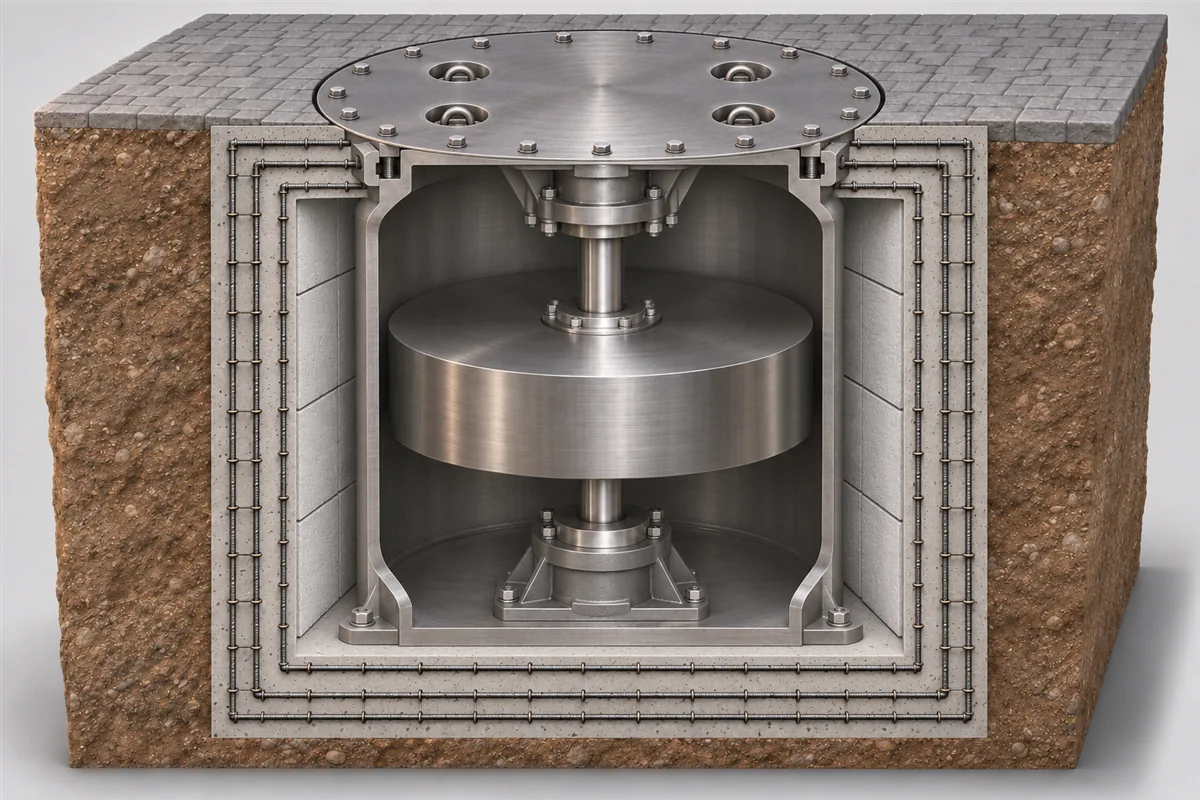
Containment and Protective Enclosures
Enclosures that contain fragments and control blast pressure, so an accident in one room stays in that room.
Learn more →Common Questions
What is quantity-distance (QD) in explosives safety?
Quantity-distance is the minimum separation between a potential explosion site and an exposed site, set by the hazard division and the net explosive weight for QD. Distances are written as D = K x W^(1/3), where K reflects the risk assumed or permitted. For DoD facilities the criteria are in DESR 6055.09.
How is inhabited building distance calculated for HD 1.1?
For a PES other than an earth-covered magazine with more than 30,000 lb NEWQD, inhabited building distance is 40W^(1/3) up to 100,000 lb and 50W^(1/3) above 250,000 lb, with a transition equation between. Below 30,000 lb, fragments and debris control, with a minimum hazardous fragment distance of 1,250 ft for 451 to 30,000 lb. Public traffic route distance is 60 percent of the applicable distance.
Who approves an explosives safety site plan?
The DoD Component approves the site plan in its transmittal document, and the Board then reviews and approves it under DESR V1.E5.2. Some cases listed in DESR V1.E5.3 do not need Board submission but still follow Component rules. A consultant such as PNH prepares the analysis and supporting content but does not approve the plan.
Did DESR 6055.09 replace DoD 6055.09-M?
Yes. DESR 6055.09, Edition 1, dated January 13, 2019, replaced DoD 6055.09-M, Volumes 1 to 8. The current version on DENIX is Edition 1, Change 2, dated November 25, 2025.
Can blast analysis justify a shorter separation distance?
Yes, in defined ways. Protective construction such as approved earth-covered magazines, barricades and engineered containment can reduce distances when the justification is submitted with the site plan, and risk-based siting may be used when QD cannot be met. The analysis is typically based on UFC 3-340-02 and must be accepted through the site plan approval process.
What applies to commercial explosives storage outside DoD?
Commercial storage in the United States follows the ATF tables of distances in 27 CFR 555.218 to 555.224, and state or local authorities may adopt NFPA 495. Internationally, IATG 02.20 provides voluntary guidance on quantity and separation distances that states can use to develop national standards.
Discuss Your Project With PNH
Send the site and the question. PNH replies within one business day.
- The siteAn address, a site plan or a few photos.
- The concernThe threat question, an incident or a client requirement.
- The criteriaAny standard or client specification that applies.
- The dateWhen the tender, review or decision is due.
Email pnhsec@pnhsec.com or call +1-818-253-9557