Author: Pedram Hesam, PhD, PSP
President & Chief Technical Officer at PNH
Counterterrorism Engineering SME
pedram@pnhsec.com
President & Chief Technical Officer at PNH
Counterterrorism Engineering SME
pedram@pnhsec.com
2026-08-19 · A Protective Design Engineering Monograph · PNH Security Briefing Series, Special Publication
Abstract
Vehicle ramming has matured from an improvised terrorist tactic into a persistent, evolving threat to public spaces, and the rapid electrification of the vehicle fleet has quietly rewritten its underlying physics. This monograph consolidates, expands, and updates a series of protective design briefings published by the author between April and May 2025, integrating them into a single analytical framework. It examines the full threat spectrum — from common sedans and SUVs to multi-ton commercial trucks — through a two-category classification model grounded in incident analysis from 2016 through 2025; develops a technical threat profile of the modern electric vehicle across four dimensions (mass, acceleration, acoustic signature, and post-crash battery hazards); audits the principal vehicle security barrier standards (ASTM F2656/F2656M, ASTM F3016, PAS 68, IWA 14-1, and ISO 22343-1:2023) against the capabilities of the electrified fleet; and presents a human-centric protective design methodology that reconciles crash-rated hostile vehicle mitigation (HVM) with the openness, accessibility, and civic character of public space. The monograph closes with a unified assessment-to-verification methodology for practitioners and an examination of emerging attack vectors, including cyber-physical exploitation and charging infrastructure vulnerabilities. The central argument is that protective design must shift from prescriptive, category-based practice to performance-based engineering that models the vehicles attackers actually select — increasingly, vehicles that are heavier, faster, and quieter than the ones our standards were written for.
About the Author
Pedram Hesam, PhD, PSP, is President and Chief Technical Officer at PNH, where he leads protective design engineering practice with a focus on perimeter security, hostile vehicle mitigation, and physical security assessment for critical facilities and public venues. He is co-author of “Mitigating Vehicle Ramming Threats with Layered Protection” (Security Management, ASIS International, September 2025).
A Note on Sources
This monograph is a consolidated and substantially expanded edition of three briefings originally published by the author in the PNH Security Briefing Series: “Vehicle Ramming Threat Mitigation: A Human-Centric Protective Design Engineering Approach” (13 April 2025); “Electric Vehicles as a Weapon: Understanding the Emerging Threat in the Era of Electrified Mobility” (15 April 2025); and “Redefining the Threat: Small and Large Vehicle Ramming Attacks in the Urban Landscape” (14 May 2025). New material includes the unified threat framework, the expanded standards audit incorporating ISO 22343-1:2023, the New Orleans case analysis, the integrated assessment methodology, and all connective and concluding chapters. A related treatment of layered protection appears in the author’s co-authored article in Security Management (September 2025), which is cited but not reproduced here.
Chapter 1 — Introduction: The Kinetic Weapon Hiding in Plain Sight
On the evening of 14 July 2016, families gathered along the Promenade des Anglais in Nice, France, to watch Bastille Day fireworks. The driver of a 19-tonne cargo truck deliberately accelerated through the crowd, killing 86 people and injuring more than 430 in a matter of minutes, using nothing more than the weight and speed of the vehicle. In that short interval, an ordinary commercial truck was transformed into one of the deadliest weapons deployed against a Western civilian population in the modern era.
Nice was neither the first vehicle ramming attack nor the last, but it marked a turning point in how the protective design community understood the threat. In the decade since, deliberate vehicle assaults (DVAs) have struck Christmas markets in Berlin and Magdeburg, bridges and shopping streets in London and Stockholm, tourist promenades in Barcelona, parade routes in Waukesha, festival grounds in Vancouver, and the heart of the French Quarter in New Orleans. The attack method is frighteningly simple: a motivated actor turns a rental truck, a delivery van, or a high-performance passenger vehicle into a kinetic weapon with little preparation, no specialized training, and no need to acquire contraband. The weapon is legally available on every street.
Three developments compel a fresh, consolidated treatment of this threat now.
Nice was neither the first vehicle ramming attack nor the last, but it marked a turning point in how the protective design community understood the threat. In the decade since, deliberate vehicle assaults (DVAs) have struck Christmas markets in Berlin and Magdeburg, bridges and shopping streets in London and Stockholm, tourist promenades in Barcelona, parade routes in Waukesha, festival grounds in Vancouver, and the heart of the French Quarter in New Orleans. The attack method is frighteningly simple: a motivated actor turns a rental truck, a delivery van, or a high-performance passenger vehicle into a kinetic weapon with little preparation, no specialized training, and no need to acquire contraband. The weapon is legally available on every street.
Three developments compel a fresh, consolidated treatment of this threat now.
First, the threat spectrum has widened downward. Early mass-casualty attacks were dominated by large commercial vehicles, and much of the protective infrastructure installed in response was implicitly designed around that profile. Recent incident data show a pronounced shift toward small, common vehicles — sedans, SUVs, and pickup trucks — that are easier to acquire, harder to flag, and more maneuverable in constrained urban environments. A defensive posture calibrated only to the 7.5-tonne lorry misses most of the contemporary attack surface.
Second, the fleet itself has changed. Electric vehicles now constitute a rapidly growing share of vehicles on the road, and their defining engineering characteristics — battery-driven mass, near-instantaneous torque, and silent low-speed operation — map with uncomfortable precision onto the attributes an attacker values. The 1 January 2025 Bourbon Street attack, carried out with a rented electric pickup truck selected, investigators concluded, for exactly those characteristics, moved this concern from the hypothetical to the operational.
Third, the standards environment is in transition. The publication of ISO 22343-1:2023 as the international successor to PAS 68 and IWA 14-1, alongside the established American ASTM F2656/F2656M and F3016 regimes, gives practitioners a stronger testing foundation than at any prior point — yet all of these frameworks were conceived before the electrified fleet reached scale, and none yet fully accounts for its mass distribution, acceleration profile, or post-crash battery hazards.
Second, the fleet itself has changed. Electric vehicles now constitute a rapidly growing share of vehicles on the road, and their defining engineering characteristics — battery-driven mass, near-instantaneous torque, and silent low-speed operation — map with uncomfortable precision onto the attributes an attacker values. The 1 January 2025 Bourbon Street attack, carried out with a rented electric pickup truck selected, investigators concluded, for exactly those characteristics, moved this concern from the hypothetical to the operational.
Third, the standards environment is in transition. The publication of ISO 22343-1:2023 as the international successor to PAS 68 and IWA 14-1, alongside the established American ASTM F2656/F2656M and F3016 regimes, gives practitioners a stronger testing foundation than at any prior point — yet all of these frameworks were conceived before the electrified fleet reached scale, and none yet fully accounts for its mass distribution, acceleration profile, or post-crash battery hazards.
This monograph integrates three strands of the author’s prior work — threat-spectrum analysis, electric vehicle threat characterization, and human-centric protective design — into a single framework, and extends them with a standards audit and a unified assessment methodology. Chapter 2 establishes the two-category threat spectrum and the cross-cutting patterns visible in a decade of incidents. Chapter 3 develops the technical threat profile of the modern EV. Chapter 4 audits the barrier-testing standards landscape against that profile. Chapter 5 presents the human-centric design approach through a comparative site analysis. Chapter 6 sets out an integrated methodology from vehicle ramming assessment through simulation-based verification. Chapter 7 examines emerging vectors — cyber-physical exploitation, charging infrastructure, and autonomous platforms — and Chapter 8 concludes.
The thesis running through every chapter is this: effective hostile vehicle mitigation in the electrified era must be performance-based rather than prescriptive, engineered around the measured capabilities of the vehicles attackers actually select; and it must be human-centric, because a public space hardened into a fortress has failed in a different but equally real way. Security and civic vitality are not competing goods. They are a single design problem.
The thesis running through every chapter is this: effective hostile vehicle mitigation in the electrified era must be performance-based rather than prescriptive, engineered around the measured capabilities of the vehicles attackers actually select; and it must be human-centric, because a public space hardened into a fortress has failed in a different but equally real way. Security and civic vitality are not competing goods. They are a single design problem.
Chapter 2 — The Threat Spectrum: Small and Large Vehicle Attacks
Vehicle ramming attacks exploit the intersection of two ubiquitous conditions: the universal availability of motor vehicles and the openness of pedestrian environments. Analysis of incidents from 2016 through 2025 supports a two-category classification that is more useful to the protective designer than conventional vehicle-type taxonomies, because it organizes the threat by operational characteristics rather than by body style.
2.1 Category A: Small Vehicles
Category A comprises sedans, SUVs, pickup trucks, and light vans — vehicles that are everywhere, arouse no suspicion, require no special license, and handle nimbly in constrained corridors. Their tactical advantages to an attacker are precisely their ordinariness: they circumvent behavioral detection, navigate access routes and gaps that would stop a truck, and can penetrate perimeter schemes that were rated (or improvised) against larger vehicles.
Representative Category A incidents include:
Representative Category A incidents include:
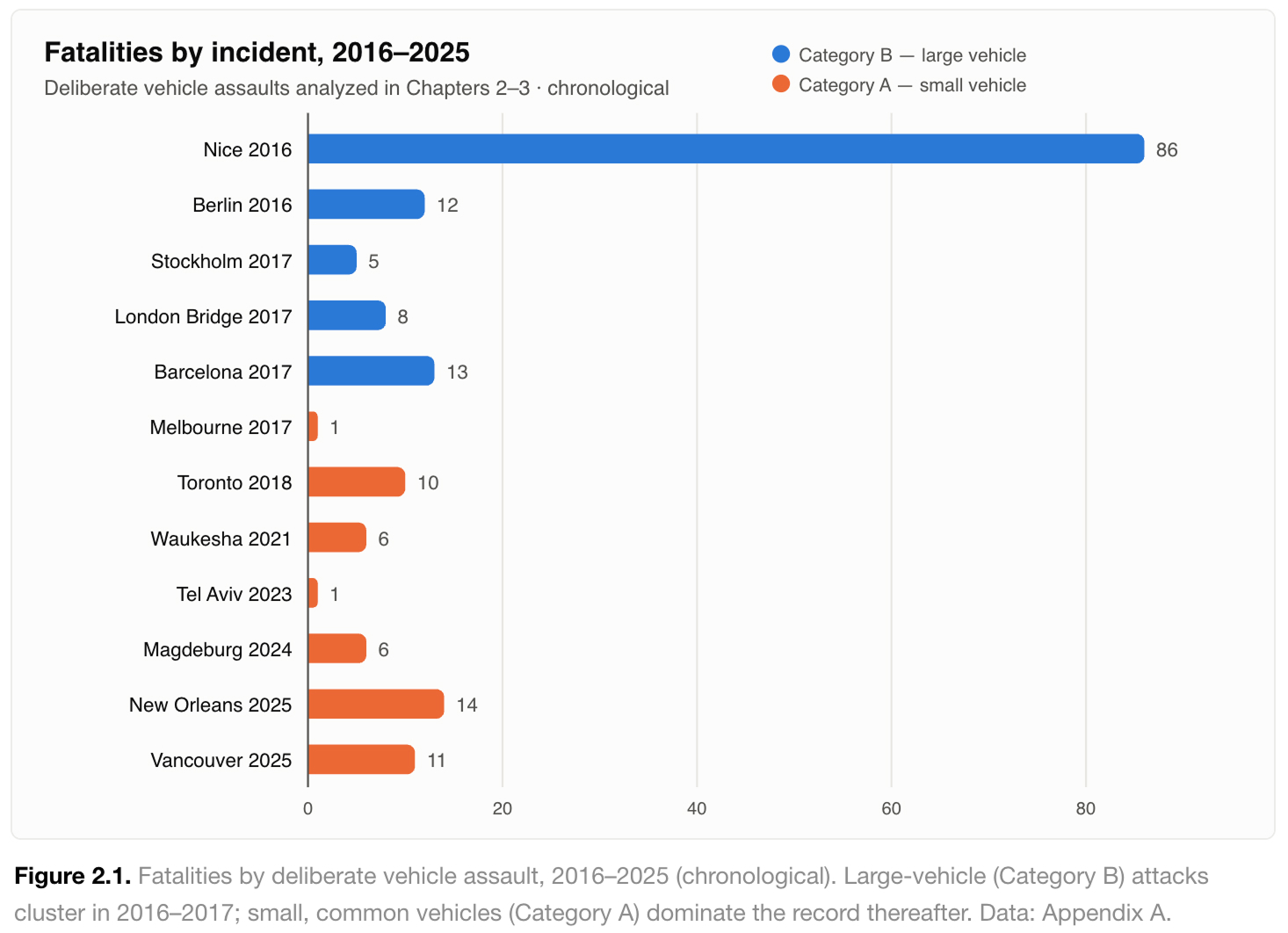
- Melbourne, Australia (21 December 2017). An SUV was deliberately driven through a crowded intersection at Flinders Street, killing one person and injuring at least 17.
- Toronto, Canada (23 April 2018). A rented van was driven along the Yonge Street sidewalk, killing 10 and injuring 16 — a light commercial vehicle operating with Category A tactics on an unprotected pedestrian corridor.
- Waukesha, Wisconsin (21 November 2021). An SUV penetrated the route of a Christmas parade, killing 6 and injuring more than 60, demonstrating how easily a standard civilian automobile defeats an event perimeter composed of soft closures.
- Tel Aviv, Israel (7 April 2023). A passenger vehicle was driven into pedestrians and cyclists on a waterfront promenade, killing one and injuring at least seven.
- Magdeburg, Germany (20 December 2024). A rented passenger car was driven at high speed some 400 meters through a Christmas market, killing 6 and injuring approximately 300 — a Category A vehicle producing Category B-scale casualties through unimpeded access to extreme crowd density.
- New Orleans, Louisiana (1 January 2025). A rented electric pickup truck was driven at speed down Bourbon Street during New Year celebrations, killing 14 victims and injuring dozens. This incident is examined in detail in Chapter 3.
- Vancouver, Canada (26 April 2025). An SUV overcame light temporary event fencing at the Lapu-Lapu Day festival, causing multiple fatalities and demonstrating the failure mode of non-crash-rated temporary barriers against even modest vehicle mass and velocity.
2.2 Category B: Large Vehicles
Category B comprises heavy commercial trucks and lorries. Vans occupy the boundary between the categories and are classified here by their tactical profile — acquisition planning, mass, and use — rather than body style alone; the London and Barcelona attacks below, though van-borne, followed the Category B pattern of premeditated acquisition against high-density targets. Category B attacks occur less frequently — heavy vehicles are harder to acquire, more conspicuous, and more often excluded from pedestrian zones by geometry alone — but when access is achieved, their mass and momentum produce substantially higher casualty counts. Category B attacks typically show pre-planning and vehicle acquisition through theft, hijacking, or rental.
Representative Category B incidents include:
Representative Category B incidents include:
- Nice, France (14 July 2016). A 19-tonne cargo truck driven through Bastille Day crowds on the Promenade des Anglais killed 86 and injured more than 430 — among the deadliest vehicle attacks in modern history.
- Berlin, Germany (19 December 2016). A hijacked semi-trailer truck was driven through the Breitscheidplatz Christmas market, killing 12 and injuring 56.
- Stockholm, Sweden (7 April 2017). A stolen beer delivery truck was rammed down the Drottninggatan shopping street, killing 5 and injuring 14.
- London, United Kingdom (3 June 2017). Attackers drove a rented van into pedestrians on London Bridge before continuing with knife attacks at Borough Market — again the hybrid pattern.
- Barcelona, Spain (17 August 2017). A van driven down the Las Ramblas promenade killed 13 and injured more than 100.
2.3 Cross-Cutting Observations from a Protective Design Lens
Viewed together, the incident record yields four patterns that should directly shape design practice.
Target selection converges on density plus exposure. Attacked venues share two properties: dense pedestrian concentration and minimal vehicle-pedestrian separation. Parades, public markets, street festivals, promenades, and entertainment districts recur throughout the record. The implication is that risk is a property of the configuration, not the landmark; an unremarkable street becomes a high-consequence target for the hours a festival occupies it.
Temporary and sub-rated perimeters fail systematically. Cones, plastic fencing, tape lines, and un-rated street furniture were defeated or simply driven through in multiple incidents. Vancouver 2025 is the clearest recent demonstration: light event fencing offers no meaningful resistance to vehicle mass. Where temporary protection is required, it must be certified temporary protection — surface-mounted, crash-tested systems — not visual demarcation performing security theater.
Target selection converges on density plus exposure. Attacked venues share two properties: dense pedestrian concentration and minimal vehicle-pedestrian separation. Parades, public markets, street festivals, promenades, and entertainment districts recur throughout the record. The implication is that risk is a property of the configuration, not the landmark; an unremarkable street becomes a high-consequence target for the hours a festival occupies it.
Temporary and sub-rated perimeters fail systematically. Cones, plastic fencing, tape lines, and un-rated street furniture were defeated or simply driven through in multiple incidents. Vancouver 2025 is the clearest recent demonstration: light event fencing offers no meaningful resistance to vehicle mass. Where temporary protection is required, it must be certified temporary protection — surface-mounted, crash-tested systems — not visual demarcation performing security theater.
Vehicle selection is deliberate and bimodal. Attackers select small vehicles when operational flexibility and low signature matter, and large vehicles when access permits and casualty maximization is the objective. New Orleans adds a third selection logic: performance. The attacker chose an electric pickup for its weight, acceleration, and quietness — evidence that at least some adversaries are now reading the spec sheet.
Timing exploits symbolism. Events with cultural, religious, or national significance — Christmas markets, national holidays, commemorative celebrations — are disproportionately targeted, compounding casualty potential (peak crowds) with communicative effect. Protective planning for such dates should assume elevated baseline risk regardless of specific intelligence.
These patterns frame the questions the remainder of this monograph answers: What, precisely, has electrification changed about the vehicle as a weapon (Chapter 3)? Do our testing standards still describe the real threat (Chapter 4)? And how do we defeat this spectrum without turning public space into fortification (Chapters 5 and 6)?
Timing exploits symbolism. Events with cultural, religious, or national significance — Christmas markets, national holidays, commemorative celebrations — are disproportionately targeted, compounding casualty potential (peak crowds) with communicative effect. Protective planning for such dates should assume elevated baseline risk regardless of specific intelligence.
These patterns frame the questions the remainder of this monograph answers: What, precisely, has electrification changed about the vehicle as a weapon (Chapter 3)? Do our testing standards still describe the real threat (Chapter 4)? And how do we defeat this spectrum without turning public space into fortification (Chapters 5 and 6)?
Chapter 3 — The Electric Vehicle as a Weapon
3.1 Case Study: Bourbon Street, 1 January 2025
At approximately 3:15 a.m. on New Year’s Day 2025, a white Ford F-150 Lightning — an all-electric, light-duty pickup truck rented through the peer-to-peer platform Turo — was driven at speed into the crowds on Bourbon Street in New Orleans’ French Quarter. Fourteen victims were killed and at least 57 people were injured, most by vehicle impact, before the attacker was stopped in an exchange of gunfire with police.
Two facts from the subsequent investigation are of particular significance to protective design practice. First, investigators concluded that the attacker deliberately selected an electric pickup for its mass, acceleration characteristics, and quiet operation — the first prominent case in which an EV’s engineering attributes were an explicit selection criterion. Second, the street’s permanent bollard system was out of service: the bollards had been removed for replacement ahead of the Sugar Bowl, and the city’s temporary Archer barriers — acquired in 2017 precisely for such contingencies — were not deployed that night. The attack therefore illustrates simultaneously the emergence of the EV threat vector and the oldest lesson in perimeter protection: a barrier system’s effectiveness is governed by its weakest operational state, not its rated capacity.
Two facts from the subsequent investigation are of particular significance to protective design practice. First, investigators concluded that the attacker deliberately selected an electric pickup for its mass, acceleration characteristics, and quiet operation — the first prominent case in which an EV’s engineering attributes were an explicit selection criterion. Second, the street’s permanent bollard system was out of service: the bollards had been removed for replacement ahead of the Sugar Bowl, and the city’s temporary Archer barriers — acquired in 2017 precisely for such contingencies — were not deployed that night. The attack therefore illustrates simultaneously the emergence of the EV threat vector and the oldest lesson in perimeter protection: a barrier system’s effectiveness is governed by its weakest operational state, not its rated capacity.
3.2 Technical Threat Profile
The threat posed by the modern electric vehicle can be characterized along four dimensions. None is exotic; each is an ordinary consequence of EV engineering. Together they constitute a materially different weapon than the internal-combustion (ICE) vehicle of equivalent class.
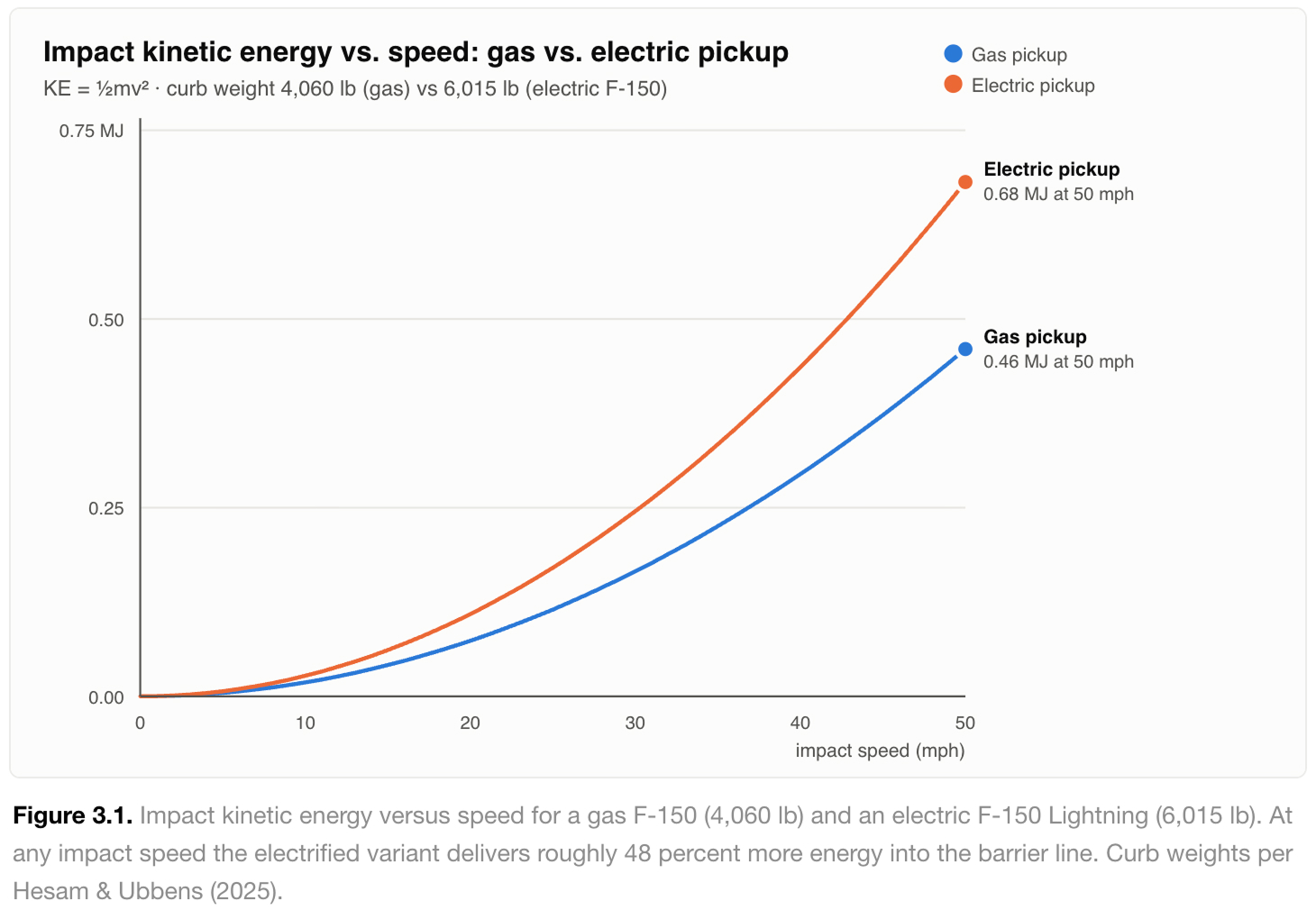
Mass. Battery packs and the reinforced structures that carry them add substantial weight. Electric pickups and SUVs commonly exceed the curb weight of their ICE counterparts by margins on the order of 30 to 50 percent; a light-duty electric pickup can carry a curb weight comparable to that of a loaded commercial van. Because kinetic energy scales linearly with mass (KE = ½mv²), a heavier vehicle at the same impact speed delivers proportionally more energy into a barrier — and barrier penetration ratings are certified against specific test-vehicle masses. A barrier that legitimately earned its rating against a 2,300 kg pickup has not been demonstrated against a 3,100 kg electrified version of the same nameplate.
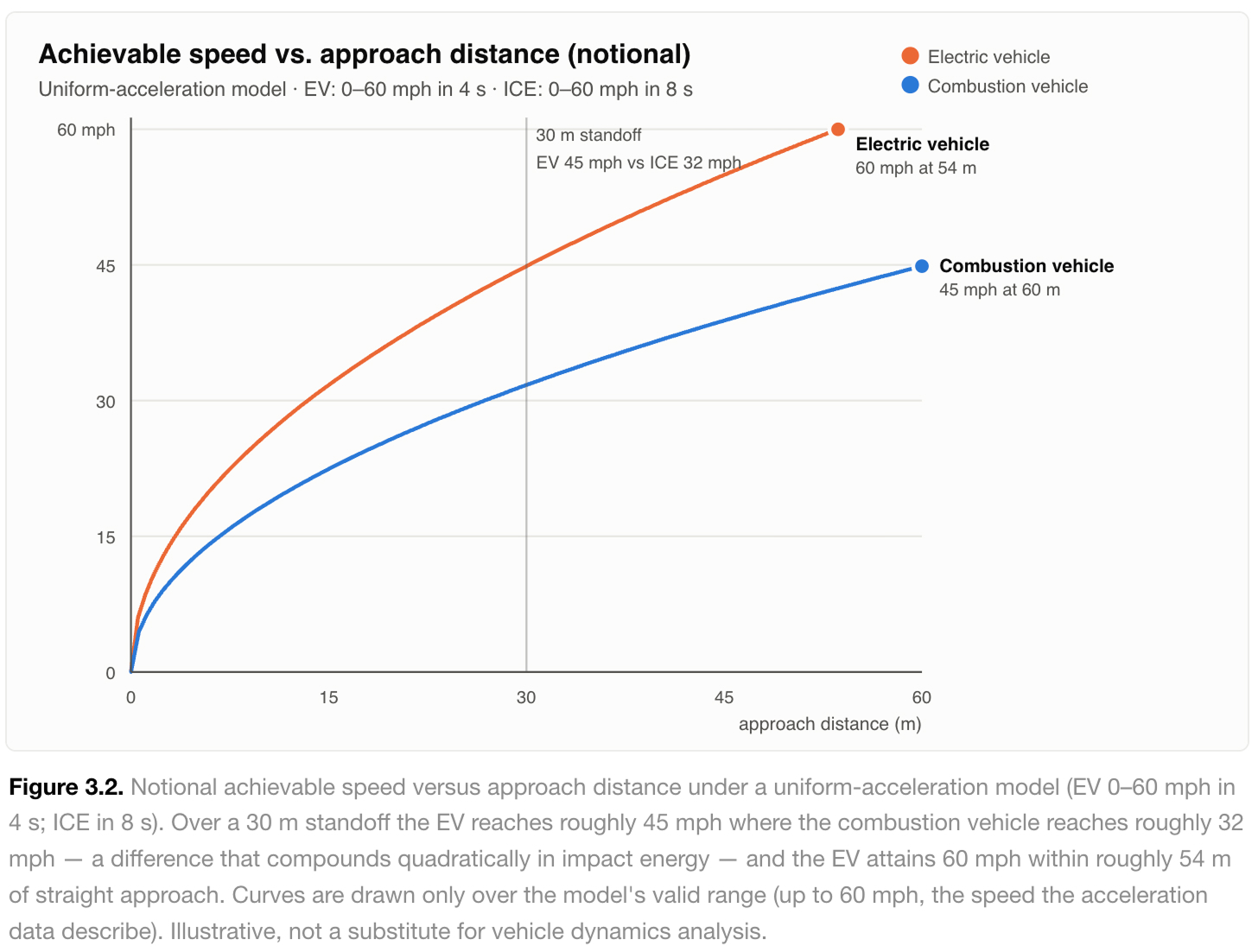
Acceleration. Electric drivetrains deliver maximum torque from a standstill. High-performance consumer EVs reach 60 mph (97 km/h) in under four seconds — roughly half the time of comparable ICE vehicles. In protective design terms, acceleration governs the achievable impact velocity over a given approach distance. Standoff distances and approach-path geometries calculated against ICE acceleration curves understate the speed an EV can attain over the same run-up, and because kinetic energy scales with the square of velocity, even modest underestimates of impact speed produce large underestimates of impact energy. Short-standoff urban sites are the most affected: an approach corridor too short for an ICE vehicle to reach barrier-defeating speed may no longer be too short for an EV.
Acoustic signature. At low speeds, EVs are nearly silent. The engine noise that has historically provided an involuntary early warning to crowds — and a cue to trained observers — is absent. In dense, noisy environments the practical detection window narrows to visual recognition alone, compressing the time available for crowd reaction, guard-force intervention, or active barrier deployment. Detection architectures that implicitly rely on auditory cues (including human ones) require supplementation with visual analytics, radar, or infrared approaches, discussed in Chapter 6.
Post-crash battery hazards. Mechanical damage to a lithium-ion traction battery can initiate thermal runaway — a self-sustaining chain reaction producing intense heat, reignition-prone fire, and toxic gas evolution. A post-impact EV at a crowded venue is therefore not merely a stopped vehicle but a potential secondary incident: a fire that resists conventional suppression, complicates casualty extraction in the immediate impact zone, and can be exploited deliberately in arson or vehicle-borne improvised explosive device (VBIED) scenarios. Emergency planning for protected venues must extend beyond stopping the vehicle to managing what the vehicle becomes after it is stopped.
Mass. Battery packs and the reinforced structures that carry them add substantial weight. Electric pickups and SUVs commonly exceed the curb weight of their ICE counterparts by margins on the order of 30 to 50 percent; a light-duty electric pickup can carry a curb weight comparable to that of a loaded commercial van. Because kinetic energy scales linearly with mass (KE = ½mv²), a heavier vehicle at the same impact speed delivers proportionally more energy into a barrier — and barrier penetration ratings are certified against specific test-vehicle masses. A barrier that legitimately earned its rating against a 2,300 kg pickup has not been demonstrated against a 3,100 kg electrified version of the same nameplate.
Acceleration. Electric drivetrains deliver maximum torque from a standstill. High-performance consumer EVs reach 60 mph (97 km/h) in under four seconds — roughly half the time of comparable ICE vehicles. In protective design terms, acceleration governs the achievable impact velocity over a given approach distance. Standoff distances and approach-path geometries calculated against ICE acceleration curves understate the speed an EV can attain over the same run-up, and because kinetic energy scales with the square of velocity, even modest underestimates of impact speed produce large underestimates of impact energy. Short-standoff urban sites are the most affected: an approach corridor too short for an ICE vehicle to reach barrier-defeating speed may no longer be too short for an EV.
Acoustic signature. At low speeds, EVs are nearly silent. The engine noise that has historically provided an involuntary early warning to crowds — and a cue to trained observers — is absent. In dense, noisy environments the practical detection window narrows to visual recognition alone, compressing the time available for crowd reaction, guard-force intervention, or active barrier deployment. Detection architectures that implicitly rely on auditory cues (including human ones) require supplementation with visual analytics, radar, or infrared approaches, discussed in Chapter 6.
Post-crash battery hazards. Mechanical damage to a lithium-ion traction battery can initiate thermal runaway — a self-sustaining chain reaction producing intense heat, reignition-prone fire, and toxic gas evolution. A post-impact EV at a crowded venue is therefore not merely a stopped vehicle but a potential secondary incident: a fire that resists conventional suppression, complicates casualty extraction in the immediate impact zone, and can be exploited deliberately in arson or vehicle-borne improvised explosive device (VBIED) scenarios. Emergency planning for protected venues must extend beyond stopping the vehicle to managing what the vehicle becomes after it is stopped.
3.3 Ideological Selection and the Symbolism of the Platform
Threat monitoring in 2024–2025 documented a rising pattern of ideologically motivated incidents in which electric vehicles were chosen either as weapons or as targets — attacks intended to communicate anti-establishment positions, or aimed at symbolically significant locations and brands. The Las Vegas Cybertruck explosion outside a hotel on the same day as the Bourbon Street attack, whatever its ultimate motive classification, reinforced public association between electrified platforms and spectacular violence. For the protective designer, the operative point is not the politics but the selection behavior: attacker choice of platform is increasingly deliberate, informed by performance characteristics and media amplification potential. Behavioral threat assessment and intelligence fusion should treat vehicle selection as signal, and predictive modeling should weight symbolically significant dates and venues accordingly.
3.4 Implications
The four-dimension profile has a direct consequence for practice: the category of a vehicle (“pickup,” “SUV,” “passenger car”) no longer reliably predicts its threat parameters. Two vehicles sharing a body style and a nameplate can differ by 800 kg of mass and a factor of two in acceleration. Threat and vulnerability assessments, barrier specifications, and standoff calculations should therefore be performed against performance envelopes — curb weight, acceleration curve, stored energy — rather than against vehicle categories. Chapter 4 examines how far the current standards landscape supports that shift, and where it falls short.
Chapter 4 — The Standards Landscape and the Adaptation Gap
Crash-rated vehicle security barriers (VSBs) are certified under a small family of test standards. Understanding what each standard actually demonstrates — and what it does not — is foundational to sound specification. This chapter surveys the principal frameworks and then audits them against the electrified threat profile of Chapter 3.
4.1 The Principal Standards
ASTM F2656/F2656M — Standard Test Method for Crash Testing of Vehicle Security Barriers. The dominant U.S. standard, ASTM F2656 rates barriers by the class and mass of the test vehicle, its impact speed, and the dynamic penetration achieved. Its familiar designations combine a vehicle/speed condition (for example, M30, M40, M50 for a medium-duty truck at 30, 40, or 50 mph) with a penetration rating (P1 through P4, from less than 1 m of penetration to greater than 30 m). The standard’s strength is its breadth of vehicle classes, from small passenger cars through heavy goods vehicles.
ASTM F3016/F3016M — Standard Test Method for Surrogate Testing of Vehicle Impact into Low-Speed Barriers. F3016 addresses the low-speed regime (nominally 10 to 30 mph) relevant to storefronts, pedestrian zones, and errant-vehicle protection, using a 5,000 lb surrogate test vehicle. It fills the gap beneath F2656’s anti-ram focus and is the appropriate reference for many streetscape and retail applications.
PAS 68 (UK) and IWA 14-1 (international). PAS 68, published by BSI, was for two decades the reference specification for hostile vehicle mitigation in the United Kingdom and much of the world, rating barriers by test vehicle mass and class, impact speed and angle, penetration, and major debris dispersion. IWA 14-1:2013 internationalized the approach under ISO’s International Workshop Agreement mechanism.
ISO 22343-1:2023 — Security and resilience — Vehicle security barriers. Published in 2023, ISO 22343-1 (performance requirement, impact test method, and rating) and ISO 22343-2 (application) supersede PAS 68 and IWA 14-1 as the international reference. The UK National Protective Security Authority (NPSA) now recognizes new crash tests only against ISO 22343 performance ratings, with products tested to the predecessor standards before March 2024 retaining validity. Relative to its predecessors, ISO 22343 introduces revised vehicle classifications, additional mass categories, stricter penetration and mobility fail conditions, and a dramatically tightened dispersed-debris threshold (from 25 kg to 2 kg) — the last a significant improvement, since major debris carried past the barrier line is itself a lethal mechanism.
Alongside these test standards sit the principal application and planning references: FEMA 426 and FEMA 430 on building and site security design; UFC 4-022-03 (U.S. Department of Defense) on security engineering for entry control and vehicle barriers; and the UK NPSA (formerly CPNI) hostile vehicle mitigation guidance suite, which remains the most mature treatment of HVM integration in public realm design.
ASTM F3016/F3016M — Standard Test Method for Surrogate Testing of Vehicle Impact into Low-Speed Barriers. F3016 addresses the low-speed regime (nominally 10 to 30 mph) relevant to storefronts, pedestrian zones, and errant-vehicle protection, using a 5,000 lb surrogate test vehicle. It fills the gap beneath F2656’s anti-ram focus and is the appropriate reference for many streetscape and retail applications.
PAS 68 (UK) and IWA 14-1 (international). PAS 68, published by BSI, was for two decades the reference specification for hostile vehicle mitigation in the United Kingdom and much of the world, rating barriers by test vehicle mass and class, impact speed and angle, penetration, and major debris dispersion. IWA 14-1:2013 internationalized the approach under ISO’s International Workshop Agreement mechanism.
ISO 22343-1:2023 — Security and resilience — Vehicle security barriers. Published in 2023, ISO 22343-1 (performance requirement, impact test method, and rating) and ISO 22343-2 (application) supersede PAS 68 and IWA 14-1 as the international reference. The UK National Protective Security Authority (NPSA) now recognizes new crash tests only against ISO 22343 performance ratings, with products tested to the predecessor standards before March 2024 retaining validity. Relative to its predecessors, ISO 22343 introduces revised vehicle classifications, additional mass categories, stricter penetration and mobility fail conditions, and a dramatically tightened dispersed-debris threshold (from 25 kg to 2 kg) — the last a significant improvement, since major debris carried past the barrier line is itself a lethal mechanism.
Alongside these test standards sit the principal application and planning references: FEMA 426 and FEMA 430 on building and site security design; UFC 4-022-03 (U.S. Department of Defense) on security engineering for entry control and vehicle barriers; and the UK NPSA (formerly CPNI) hostile vehicle mitigation guidance suite, which remains the most mature treatment of HVM integration in public realm design.
4.2 The Adaptation Gap
Measured against Chapter 3’s threat profile, four gaps emerge across this otherwise robust landscape.
Mass categories lag the fleet. Test-vehicle classes and masses were fixed when the passenger fleet was lighter. An electrified pickup can outweigh the standard pickup surrogate by hundreds of kilograms while remaining, categorically, a “pickup.” ISO 22343’s additional mass categories are a step in the right direction, but specifiers cannot assume that a rating earned against a legacy surrogate bounds the energy of the electrified vehicle most likely to be used in an attack on their site. Where the design-basis threat includes heavy EVs, specification should be driven by computed kinetic energy at the barrier line, and where necessary validated by simulation against representative EV mass and structure (Section 6.5).
Impact speed is treated as an input, not a consequence. The standards certify performance at fixed impact speeds; they are silent on whether a given site’s approach geometry allows those speeds to be reached. That was always a site-engineering responsibility, but EV acceleration resets the calculation. Vehicle dynamics assessments and standoff determinations performed with ICE acceleration assumptions should be re-run with electric performance curves; in short-approach urban conditions the difference can move a site across rating thresholds.
Post-impact behavior of the vehicle is out of scope. No current VSB standard addresses the battery hazard sequence — thermal runaway, toxic gas evolution, reignition — that follows a high-energy EV impact. Barrier certification reasonably ends when the vehicle is arrested; venue protection does not. The gap must currently be closed on the response side (Chapter 7), but future revisions of the application standards should require EV fire and gas management in the emergency planning that accompanies HVM schemes.
Classification logic remains categorical. The deepest issue is conceptual. The standards, like most threat assessments, still speak the language of vehicle categories. The recommendation advanced throughout this monograph is a shift to performance-based classification: characterizing design-basis vehicles by curb weight, acceleration capability, and stored energy, and selecting or engineering mitigation against those parameters. This aligns the specification logic with what the attacker actually exploits — and with what the New Orleans attacker demonstrably selected for.
Mass categories lag the fleet. Test-vehicle classes and masses were fixed when the passenger fleet was lighter. An electrified pickup can outweigh the standard pickup surrogate by hundreds of kilograms while remaining, categorically, a “pickup.” ISO 22343’s additional mass categories are a step in the right direction, but specifiers cannot assume that a rating earned against a legacy surrogate bounds the energy of the electrified vehicle most likely to be used in an attack on their site. Where the design-basis threat includes heavy EVs, specification should be driven by computed kinetic energy at the barrier line, and where necessary validated by simulation against representative EV mass and structure (Section 6.5).
Impact speed is treated as an input, not a consequence. The standards certify performance at fixed impact speeds; they are silent on whether a given site’s approach geometry allows those speeds to be reached. That was always a site-engineering responsibility, but EV acceleration resets the calculation. Vehicle dynamics assessments and standoff determinations performed with ICE acceleration assumptions should be re-run with electric performance curves; in short-approach urban conditions the difference can move a site across rating thresholds.
Post-impact behavior of the vehicle is out of scope. No current VSB standard addresses the battery hazard sequence — thermal runaway, toxic gas evolution, reignition — that follows a high-energy EV impact. Barrier certification reasonably ends when the vehicle is arrested; venue protection does not. The gap must currently be closed on the response side (Chapter 7), but future revisions of the application standards should require EV fire and gas management in the emergency planning that accompanies HVM schemes.
Classification logic remains categorical. The deepest issue is conceptual. The standards, like most threat assessments, still speak the language of vehicle categories. The recommendation advanced throughout this monograph is a shift to performance-based classification: characterizing design-basis vehicles by curb weight, acceleration capability, and stored energy, and selecting or engineering mitigation against those parameters. This aligns the specification logic with what the attacker actually exploits — and with what the New Orleans attacker demonstrably selected for.
4.3 Practical Guidance for Specifiers
Pending fuller standards evolution, four practices close most of the gap today: specify against the site’s computed worst-credible kinetic energy rather than against a vehicle category label; require vehicle dynamics analysis using EV acceleration data for all approach paths; treat ISO 22343-1:2023 ratings (or ASTM F2656 with explicit mass/speed justification) as the certification baseline, and reserve legacy PAS 68/IWA 14 ratings for existing installations rather than new procurement; and include post-impact EV hazards in the basis of design for emergency response infrastructure. None of these requires new technology — only the discipline of engineering to the threat as it now exists.
Chapter 5 — Human-Centric Protective Design: A Comparative Site Analysis
Hostile vehicle mitigation that succeeds as engineering can still fail as urbanism. A playground ringed by guard rails, a plaza fragmented by ranks of steel posts, a civic square that communicates siege rather than welcome — these are failures of a different kind, and they carry real costs: depressed use of public space, erosion of the civic character the space exists to provide, and, paradoxically, degraded security as under-used spaces lose the natural surveillance that active ones enjoy. This chapter develops the human-centric alternative through a comparative analysis of three configurations of the same representative site: a neighborhood playground adjacent to a public roadway — a soft target type chosen deliberately, because it concentrates the hardest version of the design problem: high vulnerability, high sensitivity to fortification aesthetics, and users who cannot be expected to self-protect.
5.1 Scenario 1: Unsecured Site with Direct Vehicular Access
The baseline configuration permits unimpeded vehicle entry: a straight roadway terminates at the playground edge with no barriers, no perimeter treatment, and no raised curb of consequence. The deficiencies compound one another. There is no standoff — no distance buffer between the point where a hostile vehicle can begin its run and the point where people are concentrated — so achievable impact velocity is limited only by the approach road. There is no deceleration opportunity and no deflection geometry; the vehicle’s path to the crowd is the path of least resistance. Response forces have effectively zero intervention time. And the configuration is equally exposed to the unintentional incursion — the medical event, the pedal error, the loss of control — which at such sites is the statistically dominant scenario. The configuration violates the site-design principles of FEMA 430 and would fail any competent vehicle ramming assessment. It is also, it must be said, the default condition of most playgrounds, markets, and gathering spaces in North America.
5.2 Scenario 2: Secured Site with Conventional Bollards
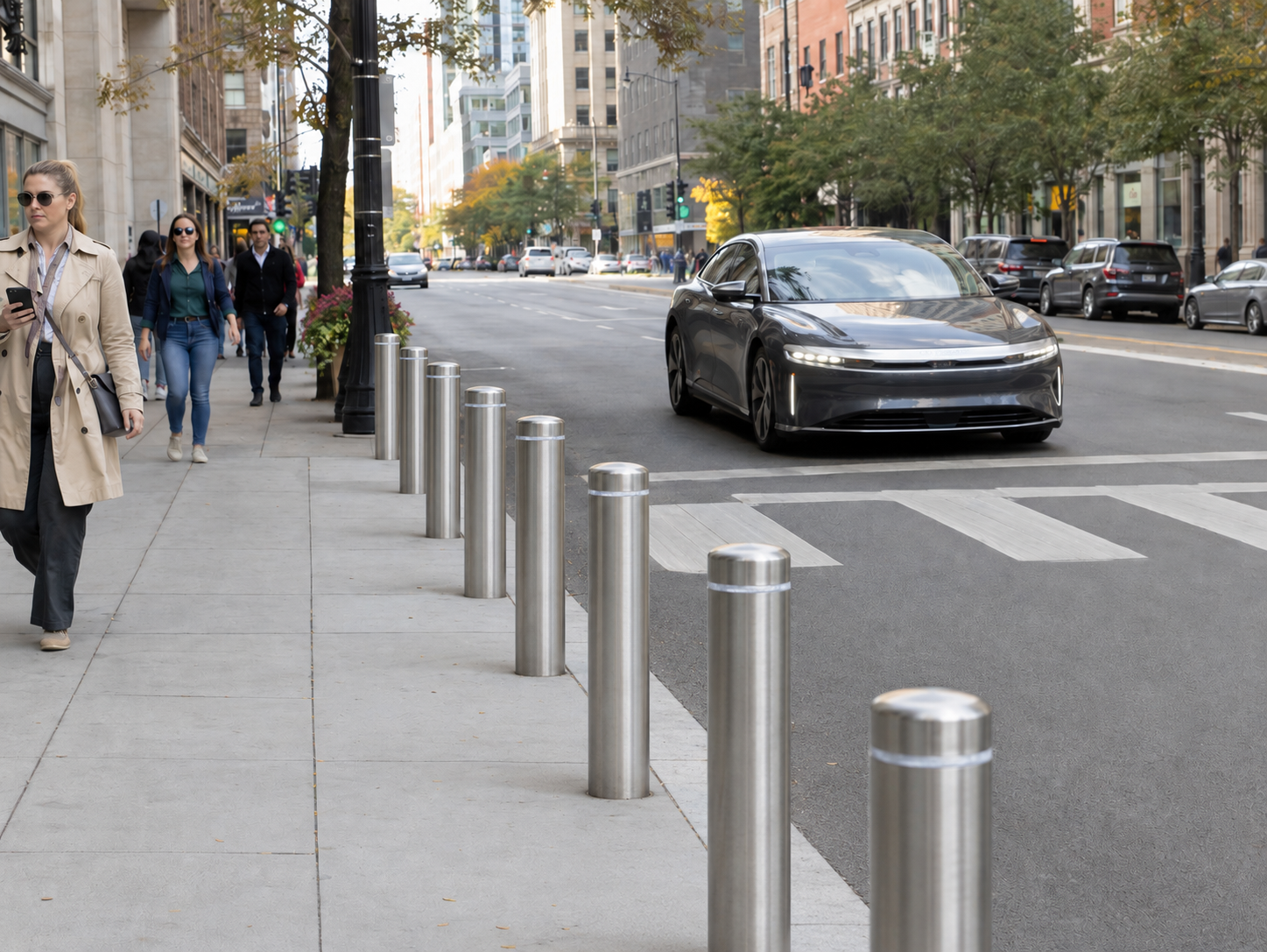
The second configuration deploys the standard remedy: a linear array of crash-rated bollards along the exposed frontage, engineered from a vehicle vector analysis and certified under ASTM F2656, PAS 68, or ISO 22343. As security engineering, this works. Properly specified and founded, crash-rated bollards reliably arrest unauthorized vehicle entry; the array establishes standoff, extends the response window, and draws a legible perimeter that simplifies surveillance and patrol.
The costs are experiential. A continuous bollard line fragments the landscape visually, constrains pedestrian circulation and stroller/wheelchair movement at precisely the edge where access matters, and projects a fortified atmosphere that reads as institutional at best and hostile at worst — a particular liability in child-oriented and recreational environments. The scheme meets FEMA guidance and the requirements of a vehicle ramming assessment, but if implemented without design intent it purchases security at the price of the site’s civic quality. Scenario 2 is not wrong; it is incomplete.
The costs are experiential. A continuous bollard line fragments the landscape visually, constrains pedestrian circulation and stroller/wheelchair movement at precisely the edge where access matters, and projects a fortified atmosphere that reads as institutional at best and hostile at worst — a particular liability in child-oriented and recreational environments. The scheme meets FEMA guidance and the requirements of a vehicle ramming assessment, but if implemented without design intent it purchases security at the price of the site’s civic quality. Scenario 2 is not wrong; it is incomplete.
5.3 Scenario 3: Integrated Hostile Vehicle Mitigation
he third configuration achieves Scenario 2’s protective performance by embedding the mitigation into the landscape architecture rather than laying it on top. Its elements are individually unremarkable; the design discipline lies in their arrangement and their certified cores:
This layered composition aligns with Crime Prevention Through Environmental Design (CPTED) principles: natural access control through geometry, natural surveillance preserved through open sightlines, and territorial reinforcement through coherent, cared-for design. Protection is distributed across the landscape rather than concentrated at a fence line, which also degrades more gracefully: no single element’s failure or removal — the Bourbon Street condition — collapses the scheme.
- Shallow water features — splash pads, runnels, ornamental moats — that function as vehicle deterrents and energy dissipators while serving as play and cooling amenities.
- Reinforced planters and street furniture — benches, cycle stands, lighting plinths — with crash-rated structural cores, doing barrier duty while reading as amenity.
- Curvilinear pathways and approach geometry that deny a straight run-up, disrupting vehicle trajectories and mechanically limiting achievable speed — a passive control of exactly the parameter (impact velocity) that EV acceleration most threatens.
- Strategically positioned crash-rated barriers — fixed or retractable bollards — reserved for the highest-risk access points where certified stopping power is non-negotiable, their visual weight minimized because they no longer carry the scheme alone.
This layered composition aligns with Crime Prevention Through Environmental Design (CPTED) principles: natural access control through geometry, natural surveillance preserved through open sightlines, and territorial reinforcement through coherent, cared-for design. Protection is distributed across the landscape rather than concentrated at a fence line, which also degrades more gracefully: no single element’s failure or removal — the Bourbon Street condition — collapses the scheme.
5.4 The Design Principle
The comparison yields the monograph’s central design principle: security performance and civic quality are jointly achievable, but only when protective design enters the project as architecture rather than arriving afterward as equipment. Scenario 3 costs more in design effort than Scenario 2 and less in civic damage; over the life of a public space, that trade is nearly always correct. The practitioner’s task is to make the security case in the vocabulary of the landscape architect and the city — standoff as setback, deflection as geometry, barriers as furniture — and to hold the line on the non-negotiables: certified ratings at critical access points, engineered foundations, and verified performance (Chapter 6).
Chapter 6 — A Unified Methodology: From Assessment to Verified Design
The preceding chapters establish what the threat is (Chapters 2–3), what the standards demonstrate (Chapter 4), and what good design looks like (Chapter 5). This chapter consolidates the author’s practice methodology into a single sequence a practitioner can follow from first site visit to verified installation, integrating the site-specific Vehicle Ramming Assessment (VRA) with a five-stage design response and a four-layer operational model.
6.1 The Vehicle Ramming Assessment
Every engagement begins with a site-specific VRA, combining engineering analysis with real-world threat intelligence. Its components:
Threat and vulnerability mapping. Characterize the urban configuration, access corridors, approach geometries, and event conditions to identify probable attack pathways and high-vulnerability zones. Define the design-basis threat in performance terms — curb weight, acceleration envelope, stored energy — not vehicle categories, explicitly including representative electric platforms.
Impact scenario modeling. For each credible pathway, compute achievable impact velocity from approach geometry and vehicle acceleration data (EV curves controlling where they govern), and derive kinetic energy at each candidate barrier line. This is the quantitative bridge between the site and the certified ratings of Chapter 4.
Mitigation strategy development. Translate the modeled scenarios into a layered scheme: barrier positioning, traffic-calming and deflection geometry, passive landscape devices, and active/retractable systems where operational access is required.
Emergency response integration. Design for the post-event condition: occupant behavior, ingress/egress dynamics under panic, casualty extraction routes, and — for the electrified threat — EV fire and toxic gas management (Chapter 7).
Threat and vulnerability mapping. Characterize the urban configuration, access corridors, approach geometries, and event conditions to identify probable attack pathways and high-vulnerability zones. Define the design-basis threat in performance terms — curb weight, acceleration envelope, stored energy — not vehicle categories, explicitly including representative electric platforms.
Impact scenario modeling. For each credible pathway, compute achievable impact velocity from approach geometry and vehicle acceleration data (EV curves controlling where they govern), and derive kinetic energy at each candidate barrier line. This is the quantitative bridge between the site and the certified ratings of Chapter 4.
Mitigation strategy development. Translate the modeled scenarios into a layered scheme: barrier positioning, traffic-calming and deflection geometry, passive landscape devices, and active/retractable systems where operational access is required.
Emergency response integration. Design for the post-event condition: occupant behavior, ingress/egress dynamics under panic, casualty extraction routes, and — for the electrified threat — EV fire and toxic gas management (Chapter 7).
6.2 The Five-Stage Design Response
- Threat–vulnerability risk assessment — the VRA above, establishing the quantitative basis of design.
- Crash-rated barrier design — specification of certified systems (ISO 22343-1, ASTM F2656/F3016) and, where standard products do not fit, custom-engineered rated barriers; the palette spans fixed and retractable bollards, surface-mounted modular systems, reinforced street furniture, and certified mobile barriers for temporary deployments.
- Discreet integration — the Scenario 3 discipline: mitigation embedded in the architectural and landscape language of the site.
- Event-specific hardening — certified mobile and temporary systems for festivals, parades, and short-duration gatherings, deployed under a documented operational plan. The New Orleans lesson belongs here twice over: temporary protection must be crash-rated, and it must actually be deployed — an undeployed barrier inventory is a paper control.
- Simulation and verification — dynamic computational modeling using real vehicle performance data, including EV mass and acceleration characteristics, to validate the scheme end-to-end before construction and after any material change to site or threat.
6.3 The Four-Layer Operational Model
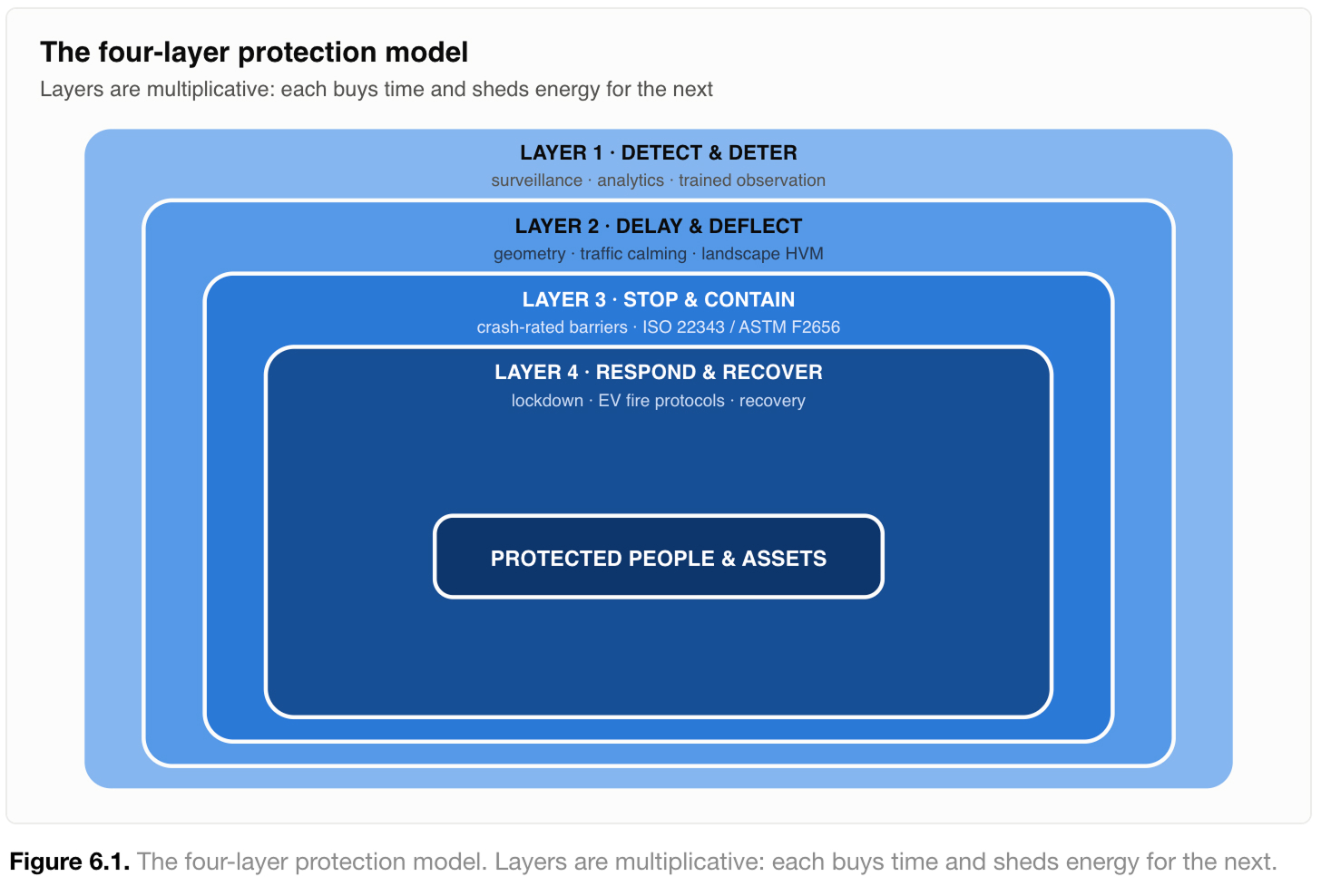
The built scheme operates within a layered protection concept, developed at greater length in the author’s Security Management treatment:
Operational measures — delivery scheduling and vendor verification, street closures during high-attendance events, and public awareness programs — bind the layers together. The layers are multiplicative, not additive: each buys time and reduces energy for the next. A scheme evaluated layer-by-layer will misjudge one that must be evaluated as a system — and it is as a system, verified by simulation against the vehicles now on the road, that protective design meets the electrified era.
- Layer 1 — Detect and deter: visible patrols, signage, open sightlines, and surveillance with AI-assisted analytics; detection designed for the silent-approach EV threat, favoring visual analytics, radar, and infrared over any implicit reliance on acoustic cues; staff trained on pre-attack indicators (slow passes, unauthorized stops, erratic approach behavior).
- Layer 2 — Delay and deflect: the geometric and landscape controls of Chapter 5 — serpentine approaches, traffic calming, reinforced furniture — spending the attacker’s velocity before the barrier line.
- Layer 3 — Stop and contain: the certified crash-rated line, specified against modeled kinetic energy.
- Layer 4 — Respond and recover: lockdown procedures, coordinated law-enforcement response, EV-specific fire protocols, and recovery planning.
Operational measures — delivery scheduling and vendor verification, street closures during high-attendance events, and public awareness programs — bind the layers together. The layers are multiplicative, not additive: each buys time and reduces energy for the next. A scheme evaluated layer-by-layer will misjudge one that must be evaluated as a system — and it is as a system, verified by simulation against the vehicles now on the road, that protective design meets the electrified era.
Chapter 7 — Emerging Vectors: Cyber-Physical, Infrastructure, and Autonomous Threats
The vehicle ramming threat will not remain purely kinetic. The same electrification and connectivity that reshaped the physical threat profile open systemic vectors that protective design practice must begin to incorporate now.
7.1 Cyber-Physical Exploitation
Modern EVs are networked computers with wheels: over-the-air software update channels, dense onboard sensor suites, and remote access interfaces create exploitation surfaces at the vehicle control, battery management, and navigation layers. A compromised vehicle need not be occupied to be dangerous. The regulatory response is underway — UNECE Regulation No. 155 mandates cybersecurity management systems in vehicle type approval, and NHTSA guidance addresses secure vehicle architecture — but venue-level protective design should already treat “vehicle under remote or software control” as a credible scenario class in high-consequence settings, with barrier schemes and access geometry providing the physical backstop that no software assurance can.
7.2 Charging Infrastructure and Supply Chain
EV charging infrastructure is itself emerging critical infrastructure — electrically energetic, networked, publicly accessible, and frequently co-located with dense parking beneath or beside occupied structures. The U.S. Department of Energy and the European Union’s NIS2 Directive have begun applying enhanced oversight. Siting and protecting charging assets should now appear within physical security assessments, both as targets and as fire-load multipliers adjacent to protected venues. Upstream, the global sourcing of battery modules, semiconductors, and telematics components creates supply-chain integrity risks that argue for vetting protocols in fleet procurement for sensitive facilities.
7.3 Post-Impact Fire: The Response Gap
Chapter 3 identified thermal runaway as the signature post-crash hazard of the electrified threat. Fire-service experience with traction battery fires is sobering: they demand suppression water volumes far exceeding conventional vehicle fires, resist extinguishment, and can reignite hours or days after apparent control, while evolving toxic gases. For protected venues, three planning consequences follow: emergency response plans must include EV-specific firefighting provisions and mutual-aid awareness; casualty collection and triage areas must be sited with post-impact fire and gas plumes in mind; and barrier line placement should, where feasible, arrest hostile vehicles at locations where a subsequent battery fire is survivable and containable. Facility fire planning should track NFPA guidance on EV and energy storage hazards as it matures.
7.4 Autonomy and Multi-Vector Scenarios
Looking forward, security frameworks must anticipate autonomous-vehicle tactics — a hostile actor need not be in the vehicle at all — as well as coordinated multi-vehicle (“swarm”) operations, explosive delivery by EV platform (the VBIED with a battery accelerant), and combined cyber-physical attacks in which digital disruption of detection or barrier systems precedes a kinetic strike. None of these requires exotic capability; all recombine existing technology. The defensive posture that meets them is the one this monograph has argued throughout: layered, performance-based, verified by simulation, and operationally disciplined.
Chapter 8 — Conclusion: Security at the Pace of Technology
The vehicle ramming threat of 2026 is not the threat of 2016 with newer vehicles. It is structurally different. The attack fleet has broadened downward into the ordinary sedan and SUV; it has grown heavier, faster, and quieter through electrification; and it has acquired post-impact behaviors — thermal runaway chief among them — that extend the incident past the moment of arrest. The attacker’s selection logic has kept pace: Bourbon Street demonstrated an adversary reading performance specifications, and a barrier system defeated not at its rated capacity but in its operational gap.
The professional response must move on four fronts simultaneously. Classification: threat assessment and barrier specification should be performance-based — mass, acceleration, stored energy — because the category label no longer bounds the threat. Standards: practitioners should specify to ISO 22343-1:2023 and the ASTM regimes with explicit kinetic-energy justification, while pressing the standards community to close the mass, acceleration, and post-impact gaps identified in Chapter 4. Design: hostile vehicle mitigation should be human-centric and layered — embedded in landscape and architecture, certified where it must stop, geometric where it can slow, and never dependent on a single element or a single operational state. Operations: deployment discipline, EV-aware detection, and EV-specific emergency response convert engineered capacity into delivered protection.
Communities should not have to choose between vibrant public space and protected public space. The comparative analysis of Chapter 5 and the methodology of Chapter 6 are offered as evidence that they need not — that protective design, practiced as architecture and verified as engineering, can hold both. What it cannot do is stand still. The fleet on the road is changing faster than the standards that describe it and the infrastructure that resists it. Security must evolve at the pace of technology — if not faster.
The professional response must move on four fronts simultaneously. Classification: threat assessment and barrier specification should be performance-based — mass, acceleration, stored energy — because the category label no longer bounds the threat. Standards: practitioners should specify to ISO 22343-1:2023 and the ASTM regimes with explicit kinetic-energy justification, while pressing the standards community to close the mass, acceleration, and post-impact gaps identified in Chapter 4. Design: hostile vehicle mitigation should be human-centric and layered — embedded in landscape and architecture, certified where it must stop, geometric where it can slow, and never dependent on a single element or a single operational state. Operations: deployment discipline, EV-aware detection, and EV-specific emergency response convert engineered capacity into delivered protection.
Communities should not have to choose between vibrant public space and protected public space. The comparative analysis of Chapter 5 and the methodology of Chapter 6 are offered as evidence that they need not — that protective design, practiced as architecture and verified as engineering, can hold both. What it cannot do is stand still. The fleet on the road is changing faster than the standards that describe it and the infrastructure that resists it. Security must evolve at the pace of technology — if not faster.
References
- ASIS International. Security Management — Hesam, P., & Ubbens, H. (2025, 15 September). “Mitigating Vehicle Ramming Threats with Layered Protection.” Focus on Perimeters: Bollards, Barriers, and Fencing. https://www.asisonline.org/security-management-magazine/articles/2025/09/barriers/vehicle-ramming/
- ASTM International. (2020). ASTM F2656/F2656M — Standard Test Method for Crash Testing of Vehicle Security Barriers.
- ASTM International. (2019). ASTM F3016/F3016M — Standard Test Method for Surrogate Testing of Vehicle Impact into Low-Speed Barriers.
- British Standards Institution. PAS 68 — Impact Test Specifications for Vehicle Security Barrier Systems.
- British Standards Institution. PAS 69 — Guidance for the Selection, Installation and Use of Vehicle Security Barrier Systems.
- International Organization for Standardization. (2013). IWA 14-1:2013 — Vehicle Security Barriers — Part 1: Performance Requirement, Vehicle Impact Test Method and Performance Rating.
- International Organization for Standardization. (2023). ISO 22343-1:2023 — Security and Resilience — Vehicle Security Barriers — Part 1: Performance Requirement, Vehicle Impact Test Method and Performance Rating.
- International Organization for Standardization. (2023). ISO 22343-2:2023 — Security and Resilience — Vehicle Security Barriers — Part 2: Application.
- Federal Emergency Management Agency. FEMA 426 — Reference Manual to Mitigate Potential Terrorist Attacks Against Buildings.
- Federal Emergency Management Agency. FEMA 430 — Site and Urban Design for Security: Guidance Against Potential Terrorist Attacks.
- U.S. Department of Defense. UFC 4-022-03 — Security Engineering: Entry Control Facilities / Access Control Points.
- UK National Protective Security Authority (NPSA, formerly CPNI). Hostile Vehicle Mitigation (HVM) Guidance.
- National Association of City Transportation Officials (NACTO). Urban Street Design Guide.
- United Nations Economic Commission for Europe. UNECE Regulation No. 155 — Cyber Security and Cyber Security Management System.
- European Union. Directive (EU) 2022/2555 (NIS2) — Measures for a High Common Level of Cybersecurity Across the Union.
- Hesam, P. (2025, 13 April). “Vehicle Ramming Threat Mitigation: A Human-Centric Protective Design Engineering Approach.” PNH Security Briefing Series. https://pnhsec.com/tpost/h6oasbfzc1-vehicle-ramming-threat-mitigation-a-huma
- Hesam, P. (2025, 15 April). “Electric Vehicles as a Weapon: Understanding the Emerging Threat in the Era of Electrified Mobility.” PNH Security Briefing Series. https://pnhsec.com/tpost/pt650exbd1-electric-vehicles-as-a-weapon-understand
- Hesam, P. (2025, 14 May). “Redefining the Threat: Small and Large Vehicle Ramming Attacks in the Urban Landscape.” PNH Security Briefing Series. https://pnhsec.com/tpost/ldlbo1ulv1-redefining-the-threat-small-and-large-ve
- International Centre for Counter-Terrorism (ICCT). (2025). “2025 New Orleans Truck Attack: The Role of Electric Vehicles and Peer-to-Peer Platforms.” https://icct.nl/publication/2025-new-orleans-truck-attack-role-electric-vehicles-and-peer-peer-platforms
- ASIS International, Security Management — Today in Security. (2025, January). “Scrutiny of Vehicle-Ramming Prevention Methods Continues as Bourbon Street Reopens.” https://www.asisonline.org/security-management-magazine/latest-news/today-in-security/2025/january/Bourbon-Street-Reopens/
- BBC News. (2025, January). “Security Barriers Removed for Repairs Before New Orleans Attack.” https://feeds.bbci.co.uk/news/articles/cvg70eg97dgo
- Cybersecurity and Infrastructure Security Agency (CISA). Vehicle Ramming — Security Awareness for Soft Targets and Crowded Places.
- National Fire Protection Association (NFPA). Emergency Field Guide / Guidance on Electric Vehicle and Energy Storage System Fire Hazards.
Appendix A — Incident Chronology, 2016–2025
The following chronology consolidates the incidents analyzed in Chapters 2 and 3. Casualty figures reflect widely reported totals at the time of writing; figures for recent incidents may be revised as investigations conclude.
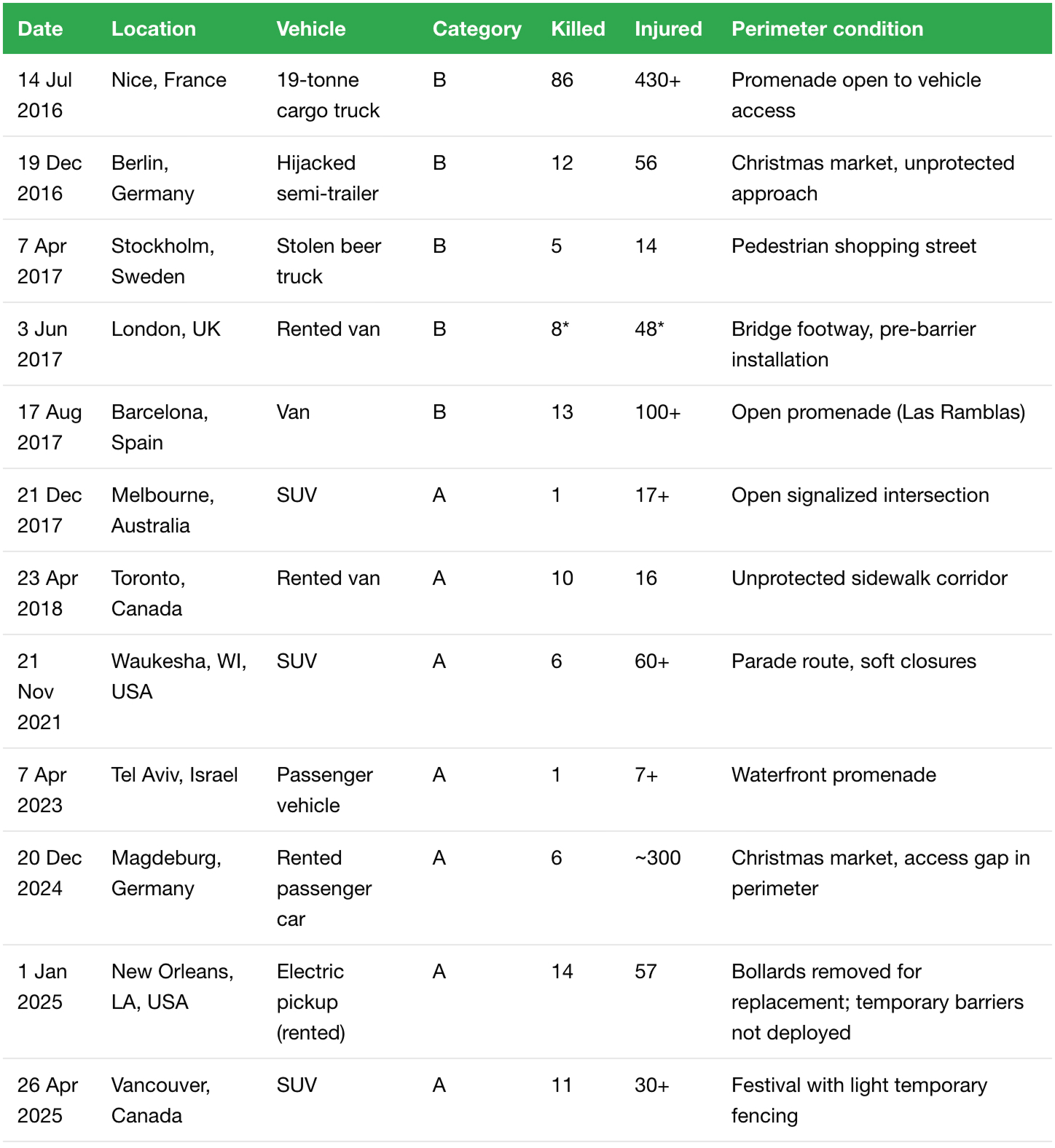
*London Bridge figures include the knife-attack phase of the combined incident.
Three structural observations emerge from the chronology read as a whole. Category B incidents cluster in 2016–2017, when large-vehicle access to pedestrian zones was still broadly unimpeded in European cities; the subsequent European investment in HVM visibly suppressed this mode. Category A incidents dominate from 2018 onward, consistent with Chapter 2’s thesis that the threat migrated downward as large-vehicle access hardened. And in no incident in this table did a properly specified, properly deployed crash-rated barrier system fail by being defeated at its rated capacity — the failures were failures of absence, of sub-rated equipment, or of operational state.
Three structural observations emerge from the chronology read as a whole. Category B incidents cluster in 2016–2017, when large-vehicle access to pedestrian zones was still broadly unimpeded in European cities; the subsequent European investment in HVM visibly suppressed this mode. Category A incidents dominate from 2018 onward, consistent with Chapter 2’s thesis that the threat migrated downward as large-vehicle access hardened. And in no incident in this table did a properly specified, properly deployed crash-rated barrier system fail by being defeated at its rated capacity — the failures were failures of absence, of sub-rated equipment, or of operational state.
Appendix B — Vehicle Ramming Assessment: Practitioner Checklist
The checklist below operationalizes the methodology of Chapter 6. It is written for high-risk facilities — schools, hospitals, government offices, event venues — but scales to any site with vehicle-pedestrian interface.
1. Site characterization
- Map all vehicle approach corridors, including curbs, medians, and landscape features an attacking vehicle could traverse.
- Record approach lengths, gradients, and surface conditions for each corridor.
- Identify crowd concentration zones by time of day and event calendar; risk is configuration-dependent, not constant.
- Document existing perimeter elements and their certification status (rated system with test certificate vs. visual demarcation).
- Record the operational state history of active systems: how often are bollards lowered, gates open, barriers removed for maintenance or events?
2. Design-basis threat definition
- Define threat vehicles by performance envelope: curb weight, 0–60 mph acceleration, and stored energy — not by body-style category.
- Include at least one representative electric platform in each vehicle class considered credible for the site.
- For rental-accessible urban sites, assume attacker access to current-generation consumer EVs including electric pickups.
3. Impact scenario modeling
- For each corridor, compute achievable impact velocity from approach geometry using vehicle-specific acceleration curves; use EV curves wherever they produce the higher speed.
- Derive kinetic energy at each candidate barrier line (KE = ½mv²).
- Test multi-directional scenarios: attack paths rarely respect the designed direction of travel.
- Where modeled energy approaches or exceeds available product ratings, iterate the geometry (lengthen deflection, shorten run-ups) before escalating the barrier specification.
4. Mitigation scheme
- Specify certified systems to ISO 22343-1:2023 or ASTM F2656/F3016 with explicit mass-and-speed justification traceable to the modeling above.
- Distribute protection across layers: geometric deflection and traffic calming upstream; certified stopping line at the protected boundary.
- Prefer integrated elements (rated furniture, planters, water features, curvilinear paths) where civic character matters; reserve overt bollard arrays for critical access points.
- For event and temporary conditions, specify certified mobile systems and write the deployment plan — trigger, responsibility, timing — into the venue’s operating procedures.
5. Detection and operations
- Design detection for the silent-approach threat: video analytics, radar, or infrared; do not rely on acoustic cues, human or technical.
- Train staff on pre-attack indicators: slow passes, unauthorized stops, probing of access points, erratic approach behavior.
- Control the legitimate-vehicle attack surface: delivery scheduling, vendor verification, and escorted access within standoff zones.
- Establish street-closure and barrier-deployment protocols for high-attendance dates, with named accountability for execution.
6. Post-impact and emergency planning
- Plan for the arrested EV as an ongoing hazard: thermal runaway, reignition, toxic gas evolution.
- Site casualty collection and triage areas clear of credible post-impact fire and plume locations.
- Coordinate with the responding fire authority on EV suppression capability and water supply at the protected site.
- Exercise the full sequence — detection, lockdown, response, recovery — not only the barrier hardware.
7. Verification and lifecycle
- Validate the final scheme by dynamic simulation against the design-basis vehicles, including EV mass and acceleration characteristics.
- Re-run the assessment after any material change: streetscape works, new vehicle classes at scale, altered event patterns, or any period of barrier removal.
- Audit operational state quarterly: the rated capacity of a removed or undeployed barrier is zero.
Appendix C — Comparative Overview of Vehicle Security Barrier Test Standards
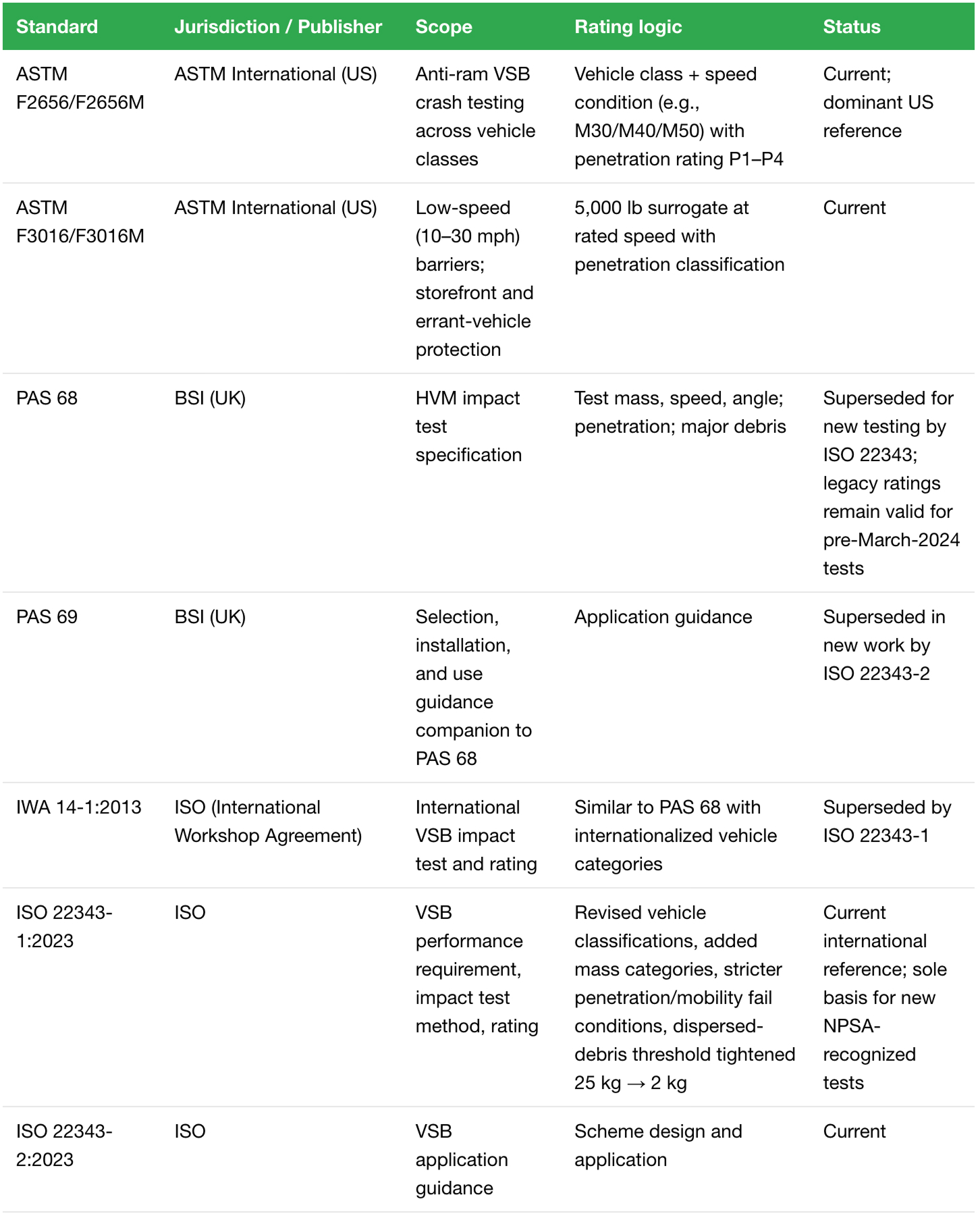
The practical reading of this table for the specifier: new procurement should reference ISO 22343-1:2023 or the ASTM regimes; PAS 68 and IWA 14 ratings on existing installed systems remain meaningful but should be mapped to modeled site energy rather than assumed equivalent; and in every case the certification answers only the question “what did this barrier stop under test conditions?” — the questions of what speed the site allows, what mass the fleet now offers an attacker, and what happens after arrest remain the engineer’s.